-
Seasonal Solar Efficiency: Why Your Backup Fails in Winter & Summer
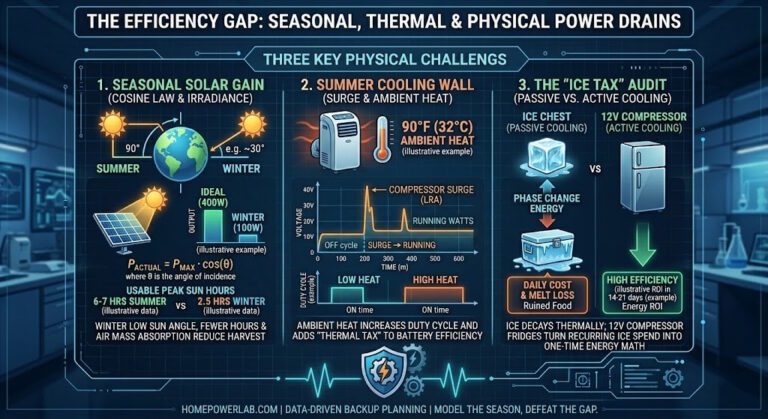
In the sales brochures for solar panels and portable air conditioners, the numbers are presented under the “Standard Test Conditions” (STC) standard. A 400W solar panel is marketed as providing 400W of power; a 2,000Wh battery is marketed as capable of running a portable AC for 2 hours. ⚡ Lab Snapshot: What This Actually Means […]
-
Emergency Electrical Safety: Modeling Voltage Drop & Thermal Failure
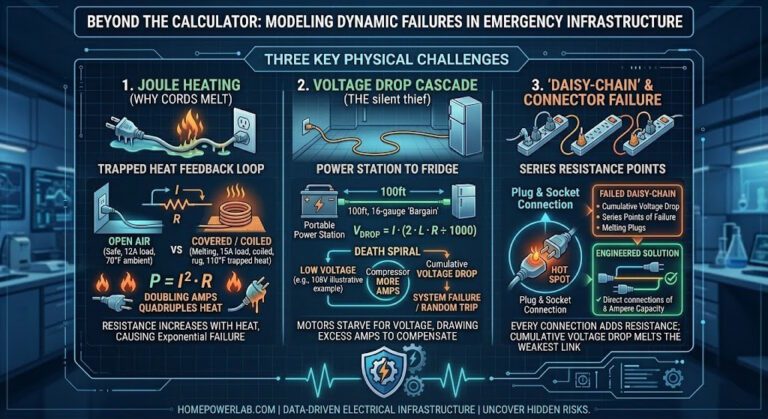
In the early stages of a power outage, the focus is almost always on the “Power Source”—the generator, the solar array, or the portable power station. However, at HomePowerLab, our testing shows that the source is rarely the cause of a system failure. The most frequent points of failure are the conductors and connections between […]
-
Starlink DC Power Efficiency: Bypassing the Inverter Tax
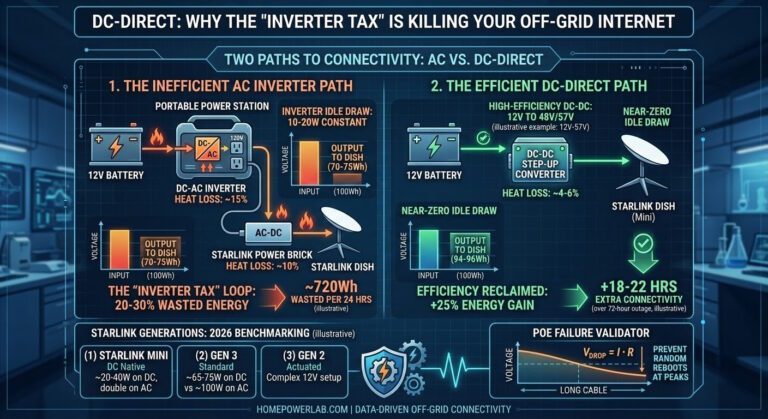
In the hierarchy of off-grid survival, communication is no longer a luxury—it is critical infrastructure. Whether for emergency coordination, remote work, or real-time weather monitoring, satellite internet systems like Starlink have become the standard for “grid-down” connectivity. However, at Home Power Lab, our real-world 2026 benchmarking reveals a massive efficiency gap in how these systems […]
-
The Physics of Critical Loads: Medical & Property Backup Math
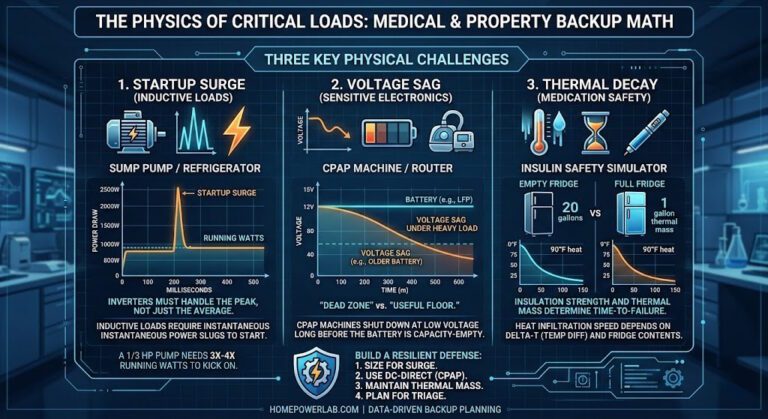
The Physics of Critical Loads In the world of emergency preparedness, there is a dangerous gap between “marketing math” and “survival physics.” Most homeowners approach backup power by looking at the battery and appliance labels, performing simple subtraction, and assuming the result is a plan. At HomePowerLab, our testing shows that this “label-to-label” approach is […]
-
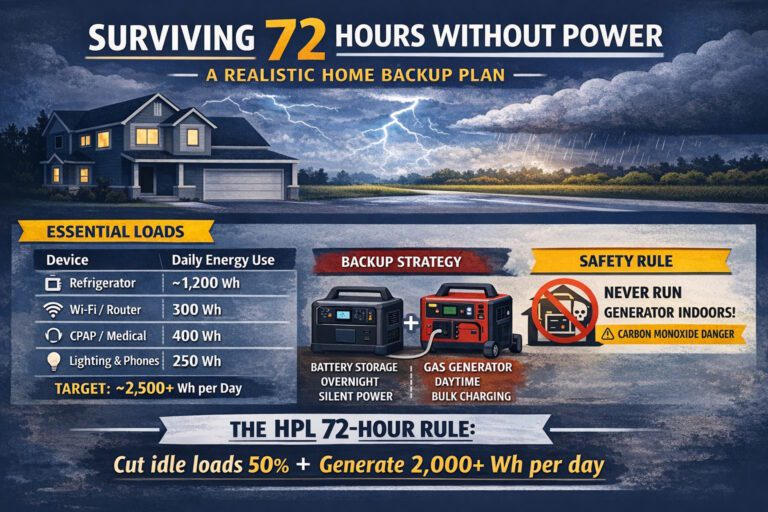
72 Hour Power Outage Plan: Realistic Energy Math for Home Survival
Start here 72 hour power outage plan What this plan is (and what it is not) This is energy triage. We prioritize food safety, communications, and critical health/heating needs under real constraints. This is not “whole-home backup.” Most portable systems fail when treated like a panel replacement. A 72-hour plan is selective. This assumes bad […]
-
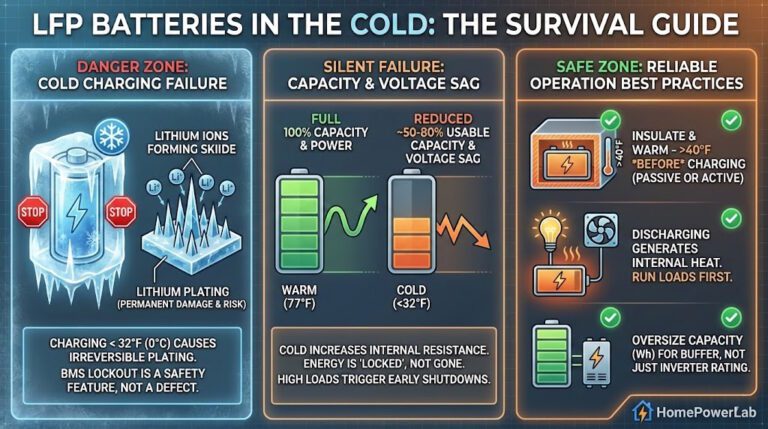
LFP Batteries in Cold Weather: Why They Fail and How to Use Them Safely
A Real-World Failure That Keeps Repeating What this article explains: This investigation explains how lithium iron phosphate (LFP) batteries actually behave in cold weather, why some failures are silent or delayed, and where real safety boundaries exist. It focuses on charging vs discharging limits, cold-induced capacity loss, and common assumptions that break during winter outages. […]

HomePowerLab.com
Real Tests. Real Runtimes.