
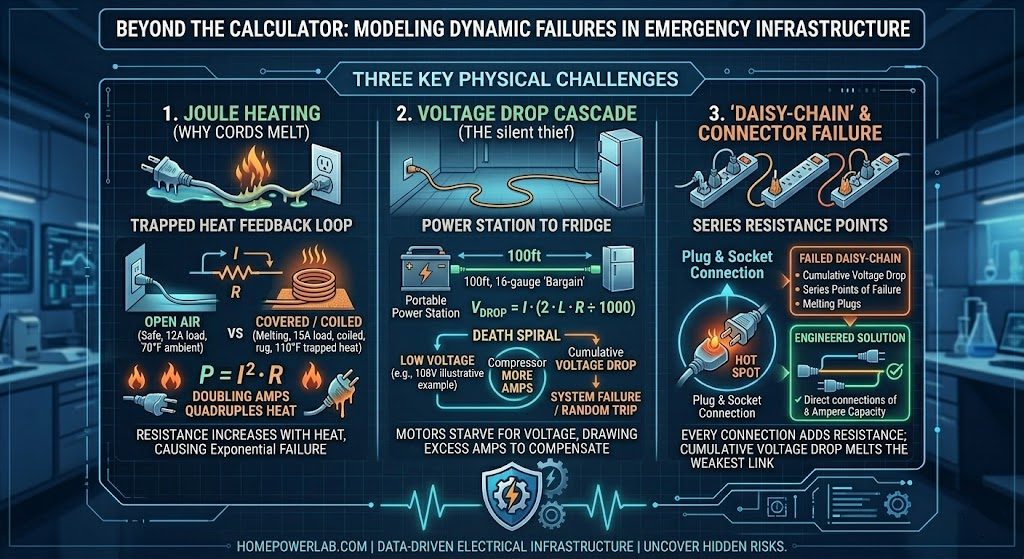
In the early stages of a power outage, the focus is almost always on the “Power Source”—the generator, the solar array, or the portable power station. However, at HomePowerLab, our testing shows that the source is rarely the cause of a system failure. The most frequent points of failure are the conductors and connections between the battery and the load.
Emergency Steps If You Smell Burning Plastic or See Electrical Damage
- Turn off the breaker supplying the circuit immediately.
- Do not continue using the outlet or appliance.
- Check nearby outlets for heat or discoloration.
- If burning odor continues, leave the area and call an electrician.
Why this article matters
In emergency power systems, cords and connectors usually fail before the battery or inverter does. The danger is not just “too many watts.” It is the combination of current, cable length, resistance, heat buildup, and weak connection points.
- Voltage drop reduces delivered power and forces equipment to pull harder.
- Joule heating turns resistance into dangerous heat, especially in undersized cords and loose plugs.
- Daisy chains multiply failure points and can create hidden hot spots long before a breaker trips.
The takeaway: a setup that “turns on” is not automatically a setup that is safe.
Most people use simple “static calculators” to size their cords. They look at a 15A rating on an extension cord and assume that if they plug in a 12A load, they are safe. This is a dangerous simplification. In an emergency, infrastructure is dynamic, not static. To ensure safety, we must move beyond the simple calculator and look at the physics of Joule Heating, Resistance Cascades, and Series Points of Failure.
In This Report: Emergency Electrical Safety
The Physics of Joule Heating: Why Cords Melt
Every wire has internal resistance. When current ($I$) flows through that resistance ($R$), it generates heat ($P$). This is known as Joule Heating, and it is governed by a squared relationship:
$$P = I^2 \cdot R$$
Because the current is squared, a small increase in the load creates an exponential increase in heat. If you double the amperage running through an extension cord, you don’t double the heat—you quadruple it.
In a “Lab” scenario, a cord might be rated for 15A in open air at 70°F. But in a real-world emergency, that cord might be coiled up, covered by a rug to prevent tripping, or sitting in a hot sunroom. This “trapped heat” increases the copper’s resistance, which in turn generates more heat. This is a Thermal Feedback Loop. If the heat cannot dissipate, the insulation reaches its melting point long before a standard circuit breaker ever trips.
How Arc Faults Cause Thermal Failure
Not all electrical overheating comes from high current alone. Many house fires begin with arc faults — tiny electrical sparks that jump between damaged or loose wires.
These arcs can reach temperatures above 5,000°F, easily hot enough to degrade insulation and ignite nearby materials.
Modern homes often use AFCI breakers (Arc Fault Circuit Interrupters). These devices monitor electrical wave patterns and shut off power if they detect the signature of an electrical arc.
If your breaker panel contains AFCI breakers, they provide an additional layer of protection against hidden wiring failures.
Danger Signs Your Emergency Power Chain Is Running Too Close to Failure
Any one of these should make you stop and inspect the entire power path before continued use:
The Voltage Drop Cascade: The Silent Power Thief
The second dynamic failure point is Voltage Drop. As current flows down a long wire, the copper’s resistance “steals” a portion of the voltage.
$$V_{drop} = I \cdot \left( \frac{2 \cdot L \cdot R}{1000} \right)$$
(Where $L$ is the one-way length and $R$ is the resistance per 1,000 feet).
While a 3% voltage drop is acceptable for household lighting, it can be fatal for sensitive electronics or induction motors. If your power station is outputting a perfect 120V, but you are using a 100-foot, 16-gauge “bargain” cord to run a refrigerator, the voltage arriving at the compressor might be as low as 108V.
When a motor-driven appliance receives low voltage, it compensates by drawing more current (Amps) to perform the same amount of work. This increased current generates more heat in the cord (see Joule Heating), further increasing resistance and lowering the voltage even more. Our Visual Circuit Builder is designed to model this specific “death spiral,” showing you where a system will brown out before you plug it in.
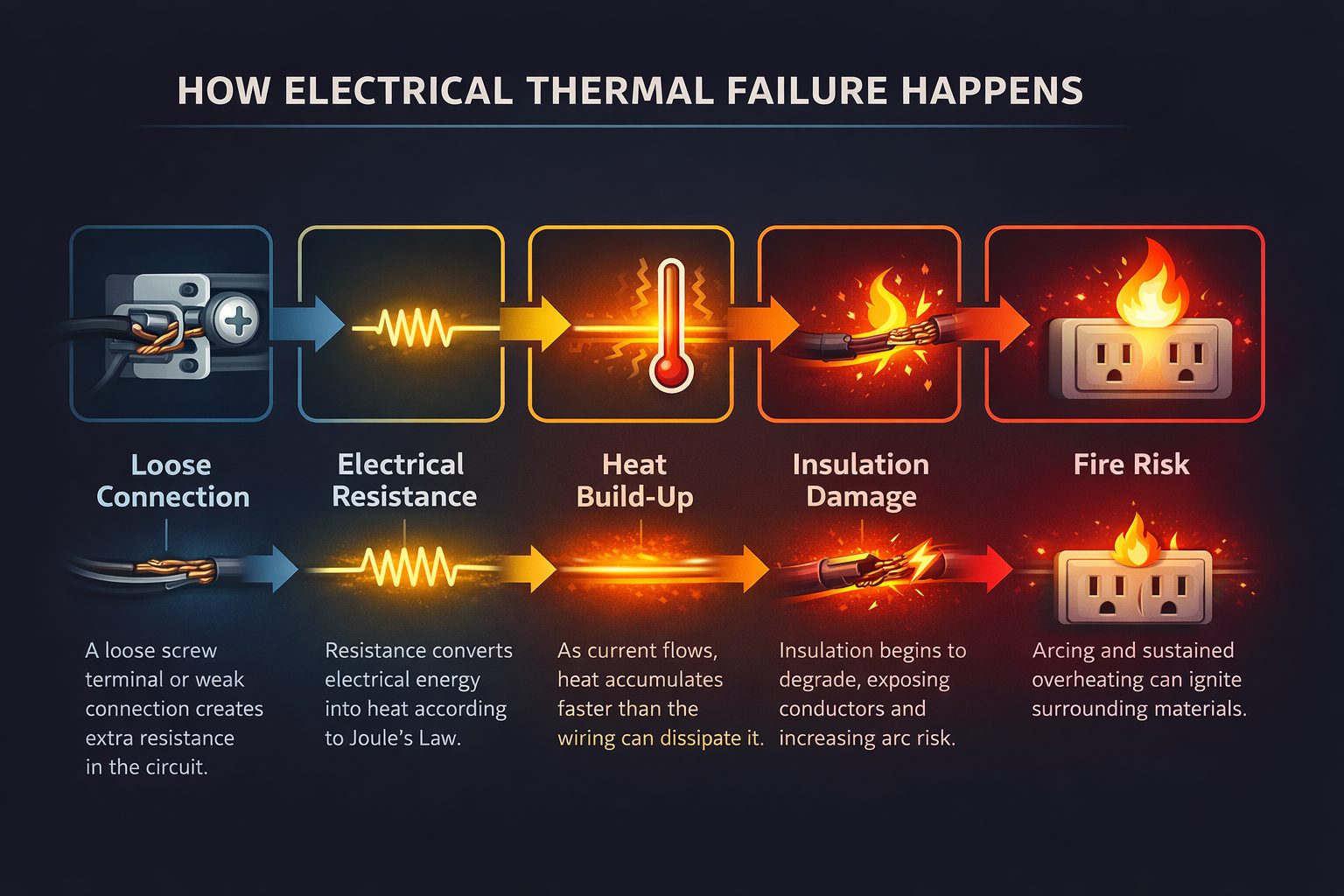
The hidden chain of electrical thermal failure. Loose connections increase resistance, resistance generates heat, and sustained heat eventually damages insulation and increases fire risk.
The “Daisy-Chain” and Series Points of Failure
During an outage, users often perform “Emergency Plumbing”—plugging a power strip into an extension cord that is plugged into another power strip. This creates Series Resistance.
Every plug-and-socket connection is a potential point of resistance. Over time, these connections can oxidize or loosen, creating “hot spots.” In a standard home circuit, these points are hidden behind walls. In a backup scenario, they are exposed on your floor.
The danger of the “Daisy-Chain” is not just the total load; it is the cumulative voltage drop across multiple contact points. A single poorly-seated plug can create enough resistance to generate 50 Watts of heat in a space the size of a postage stamp. Our tool, The Cord Audit, focuses specifically on these connection points, forcing the user to verify the physical integrity of the “weakest link” in the chain.
Hard Stop: When This Is No Longer a DIY Situation
If you see smoke, charring, or melted insulation, do not attempt to tighten screws or open the outlet box yourself.
Instead:
- Turn off the breaker supplying the circuit.
- If damage appears near the breaker panel, shut off the main breaker.
- Do not re-energize the circuit.
- Call a licensed electrician to inspect the wiring.
Thermal damage inside electrical systems can worsen quickly and may not be visible from the outside.
Common Emergency Power Setups and Their Failure Risk
This is where theory turns practical. A setup can be “under the watt limit” and still be poor from a heat, resistance, or connector-integrity standpoint.
| Setup | Main Problem | Risk Level | Why It Fails |
|---|---|---|---|
| Portable power station → short heavy-gauge cord → single moderate load | Minimal path loss | Lower | Fewer connection points and shorter conductor length keep resistance and heating relatively controlled. |
| Portable power station → long household extension cord → refrigerator | Voltage drop during startup surge | Moderate | Motor loads are sensitive to sag. Extra cord length can lower delivered voltage right when startup demand spikes. |
| Portable power station → cheap power strip → space heater | Heat concentration at connectors | High | High continuous current through light-duty strip contacts can create dangerous heating even without obvious overload. |
| Portable power station → extension cord → another extension cord → appliance | Series resistance and hidden hot spots | High | Each added junction increases resistance, weakens mechanical integrity, and multiplies thermal failure points. |
| Battery/inverter system running inside hot ambient conditions | Reduced thermal margin | Moderate to High | Higher ambient temperature means less headroom before insulation, plugs, and electronics begin operating in a failure zone. |
Why Static Calculators Fail Infrastructure Safety
A static calculator will tell you that a 14-gauge wire can handle 15 Amps. It will not tell you that if that wire is 100 feet long and powering a Starlink Gen 3 and a space heater simultaneously, the cumulative thermal load at the first outlet will exceed the safety rating of the power station’s faceplate.
We built the Visual Circuit Builder and The Cord Audit to treat infrastructure as a System. We model the branching paths of your emergency setup, accounting for the fact that heat and resistance are not constants—they vary with load, length, and environment. We also account for the Amperage Capacity of the connectors themselves, which are often the first to fail during a sustained high-draw event, such as running a portable AC.
Conclusion: Infrastructure is Part of the Plan
A $3,000 power station is useless if it is connected to a $10 extension cord that is starving the load of voltage. Resilience requires a holistic view of the power chain. By understanding the physics of resistance and the reality of Joule heating, you can transition from “plugging things in” to “engineering a solution.”
At HomePowerLab, we believe that the wire is just as important as the battery. Use our infrastructure suite to audit your cords, model your circuits, and ensure that the only thing that gets hot during your next outage is your coffee.

Leave a Reply
You must be logged in to post a comment.