
A Real-World Failure That Keeps Repeating
This investigation explains how lithium iron phosphate (LFP) batteries actually behave in cold weather, why some failures are silent or delayed, and where real safety boundaries exist. It focuses on charging vs discharging limits, cold-induced capacity loss, and common assumptions that break during winter outages.
This is not a buying guide. It is a system-level explanation intended for people planning real backup power under real stress.
The outage starts the same way every time. A winter storm takes down the grid. The house goes quiet. Someone wheels out a brand-new portable power station they bought specifically for emergencies, confident because it uses modern lithium iron phosphate (LFP) batteries and carries impressive wattage ratings.
The unit powers on. Lights flicker. A furnace blower tries to start.
Then nothing.
No alarms. No sparks. Just a silent shutdown — and later, a battery that refuses to charge once a generator or solar input becomes available.
The power station didn’t break. It did exactly what it was designed to do.
The real failure is subtler and more dangerous: the user assumed that “cold-rated” meant “cold-safe,” and that charging a lithium battery in freezing conditions was merely inefficient—not potentially destructive.
This distinction matters because some cold-weather mistakes don’t fail immediately. They fail months later, after the battery has warmed, aged, and quietly degraded in ways the user never sees coming.
Trying to use LFP Batteries in the Cold? Start Here
Why This Is Commonly Misunderstood
Careless users do not cause confusion about LFP battery behavior in cold weather. It is caused by how specifications are framed.
Manufacturers prominently advertise:
- Total capacity measured at room temperature
- Maximum inverter wattage
- Long cycle life under ideal conditions
Meanwhile, cold-weather constraints are buried in:
- Footnotes
- App warnings
- Vague “operating range” language
Even worse, marketing often collapses three very different ideas into one:
- Cold tolerance
- Cold operation
- Cold-safe charging
They are not interchangeable.
Online demonstrations compound the problem. Many tests are performed indoors, briefly outdoors, or under steady, low loads. None of these reflect what happens during an actual winter outage, when batteries sit idle overnight, loads surge unpredictably, and temperatures remain below freezing for hours or days.
The result is not reckless behavior — it is misplaced confidence.
How the System Actually Works
Understanding cold-weather behavior requires separating chemistry from electronics.
Discharging vs. Charging: The Non-Negotiable Difference
LFP batteries behave very differently when discharging versus charging in the cold.
- Discharging in cold weather
LFP cells can usually discharge below freezing, though with reduced efficiency and increased internal resistance. - Charging in cold weather
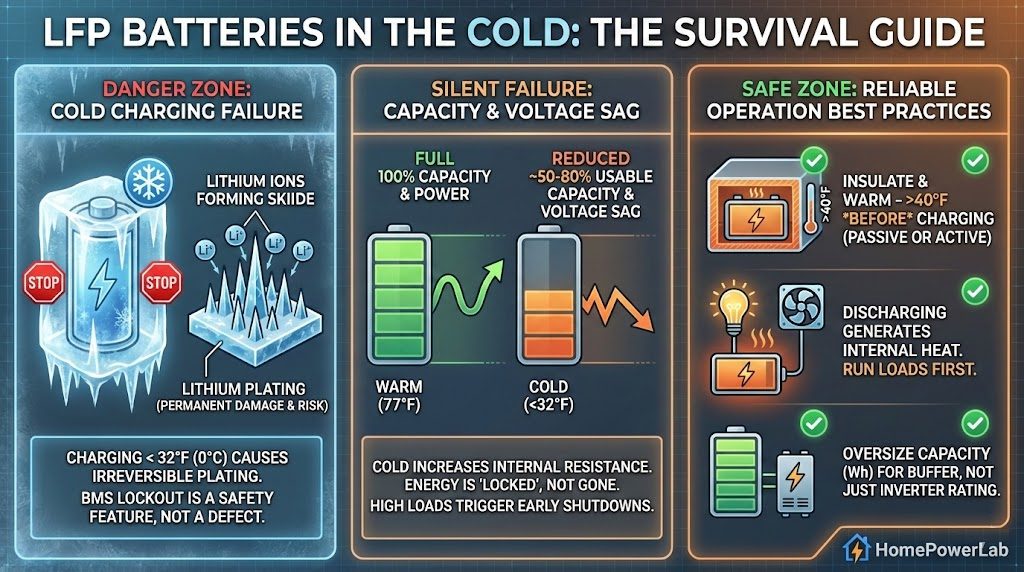
Charging below roughly 0°C / 32°F risks lithium plating — metallic lithium depositing on the anode instead of intercalating properly.
This is not a cosmetic issue.
Lithium plating can:
- Permanently reduce capacity
- Create internal dendrites
- Increase the risk of internal short circuits later in the battery’s life
Critically, the danger is often delayed. A battery cold-charged in January may appear fine “after it warms up,” only to fail catastrophically months later under summer heat and high loads.
This is why most modern LFP systems lock out charging at low temperatures. When a battery refuses to charge in winter, it is not being stubborn — it is protecting itself from long-term damage.
Why Cold Reduces Usable Capacity
As temperatures fall:
- Electrolyte viscosity increases
- Ion mobility decreases
- Internal resistance rises
This leads to voltage sag.
In plain terms:
Think of it like trying to pull honey through a straw. The colder it gets, the harder the battery has to work to deliver electricity. The “pressure” (voltage) drops even though energy remains stored.
This is why batteries can show remaining charge but still shut down under load.
Typical Usable Capacity vs Temperature
| Temperature | Estimated Usable Capacity |
|---|---|
| 25°C (77°F) | ~100% |
| 0°C (32°F) | ~80–85% |
| -10°C (14°F) | ~50–70% |
These are ranges, not guarantees. Load size and surge behavior can quickly push real-world results to the lower end.
Real-World Conditions That Change Outcomes
Cold rarely acts alone.
Thermal Soak Matters More Than Air Temperature
A battery briefly exposed to cold behaves differently from one that has equilibrated overnight. Internal mass retains heat — until it doesn’t.
Many failures occur on the second or third use cycle, after the battery has fully cooled.
The Ground Effect (Often Overlooked, Often Fatal)
Concrete floors are thermal sinks.
A battery placed directly on a garage slab or basement floor will lose heat far faster than one exposed only to cold air. The earth beneath the slab acts as a massive heat reservoir, continuously drawing heat from the battery.
Practical implication:
Getting batteries off the floor—even by a few inches—can materially improve cold performance.
This is one of the simplest, highest-impact interventions users overlook.
Load Behavior in Cold Conditions
Cold increases startup stress:
- Motors draw higher inrush current
- Compressors stall more easily
- Inverters hit protection thresholds faster
What worked in summer may fail instantly in winter.
Human Behavior During Outages
During emergencies, people stack loads, override habits, and improvise. Cold systems have less margin for improvisation.
- Is the battery physically above freezing right now?
- Is it elevated off concrete or ground contact?
- Have you checked for a low-temperature charging lockout?
- Are you starting with high-surge loads?
- Is wind stripping heat from the enclosure?
If more than one answer is “no” or “unsure,” assume reduced performance and avoid charging.
Failure Modes & Edge Cases
Cold-weather failures are often quiet and misleading.
Silent Charging Lockout (The Insider Trap)
The battery runs fine. Power input is connected. Nothing happens.
Users start swapping cables, resetting breakers, and blaming generators.
In reality, the battery management system is blocking charging due to low internal temperature.
Pro tip:
Before troubleshooting hardware, check the app or LCD for a low-temperature charging lockout icon or message. This saves hours of unnecessary frustration.
Voltage Sag Shutdowns
Moderate loads can trigger shutdowns even when apparent capacity remains. Once warmed, the battery “recovers,” masking the underlying cause.
The False Sense of Recovery
A battery that warms up and appears normal is not necessarily undamaged if it was cold-charged previously. Lithium plating damage does not announce itself immediately.
What Consistently Works (and Why)
Across brands and form factors, several principles hold.
Keep Batteries Above Freezing When Charging
This matters more than inverter size, surge rating, or advertised chemistry benefits.
Passive strategies (placement, insulation, elevation) often outperform active ones.
Integrated Self-Heating: Helpful, Not Free
Some modern LFP systems include internal heating blankets.
These can be effective, but they come with tradeoffs:
- Heaters consume battery energy
- If the battery is already low, heating may prevent usable output
- Heating systems can cycle repeatedly in windy or poorly insulated environments
Self-heating reduces risk — it does not eliminate planning requirements.
Oversize Energy, Not Power
Cold constrains energy availability more than peak wattage. Extra capacity provides a buffer against voltage sag and shutdowns.
Accept Winter Derating as Normal
Designing for 70–80% winter availability improves reliability. Designing around nameplate specs leads to disappointment.
Practical, Risk-Aware Guidance
Prioritize First
- Indoor or thermally protected placement
- Elevation off concrete
- Load sequencing
Avoid Relying On
- Outdoor winter charging without thermal control
- High-surge appliances as first loads
- Spec-sheet operating ranges without context
Test Safely at Home
- Cold-soak overnight before testing
- Start with the highest-surge loads
- Confirm battery temperature before attempting recharge
Runtime calculators and simulators are useful — but only if mentally derated for winter conditions.
HomePowerLab Perspective
At HomePowerLab, cold-weather behavior is evaluated through extended exposure rather than brief demonstrations.
In controlled wind testing, we have observed metal-cased portable power stations reaching the internal low-temperature charging lockout approximately 40% faster than plastic-cased units under identical 20 mph airflow, despite similar cell chemistry and capacity.
The lesson is not that one enclosure is “bad,” but that thermal design and placement matter as much as battery chemistry.
We treat cold as a system constraint, not an edge case.
Frequently Asked Questions About LFP Batteries in Cold Weather
Can I charge an LFP battery below freezing?
No. Charging an LFP battery below roughly 0°C (32°F) risks lithium plating, which can permanently damage the battery and increase the risk of internal short circuits later in its life. Most modern systems block cold charging automatically for this reason.
Why does my battery show charge but shut down under load?
Cold increases internal resistance. Even when energy remains stored, voltage can sag under load and trigger inverter shutdowns. This is expected cold-weather behavior, not a false capacity reading.
Is lithium plating immediately dangerous?
Not always immediately. Damage from cold charging may only surface months later under high heat or heavy loads, which is why cold charging is treated as a serious safety boundary.
Do self-heating batteries solve cold weather issues?
They help, but they are not free. Internal heaters consume battery energy and may prevent usable output if the battery is already low. Placement and insulation still matter.
Why won’t my battery charge even though power is connected?
Many systems silently block charging when internal temperature is too low. Always check the display or app for a low-temperature lockout message before troubleshooting cables or generators.
Related HomePowerLab Tools
The following tools support cold-weather planning, load modeling, and real-world backup power assumptions discussed in this article.
Estimate real-world runtime under variable loads and derate expectations for winter conditions.
Solar Reality CheckerSee how winter sun angle and weather affect real recharge timelines.
Visual Circuit BuilderMap loads, circuits, and power paths before an outage exposes weak assumptions.
Starlink Power RequirementsModel communication loads that often become critical during winter outages.
Conclusion: Preparedness as Understanding
Cold weather does not make LFP batteries unsafe by default. Misunderstanding them does.
True preparedness is not about owning more equipment. It is about knowing:
- When your system refuses to operate
- Why does that refusal exist
- How to work within those limits calmly and deliberately
An LFP battery’s performance in cold weather is predictable when its constraints are respected. That understanding — not gear accumulation — is what keeps systems reliable when conditions are worst.

Leave a Reply
You must be logged in to post a comment.