
The Physics of Critical Loads
In the world of emergency preparedness, there is a dangerous gap between “marketing math” and “survival physics.” Most homeowners approach backup power by looking at the battery and appliance labels, performing simple subtraction, and assuming the result is a plan. At HomePowerLab, our testing shows that this “label-to-label” approach is the primary cause of system failure during real-world outages.
⚙️ Lab Brief
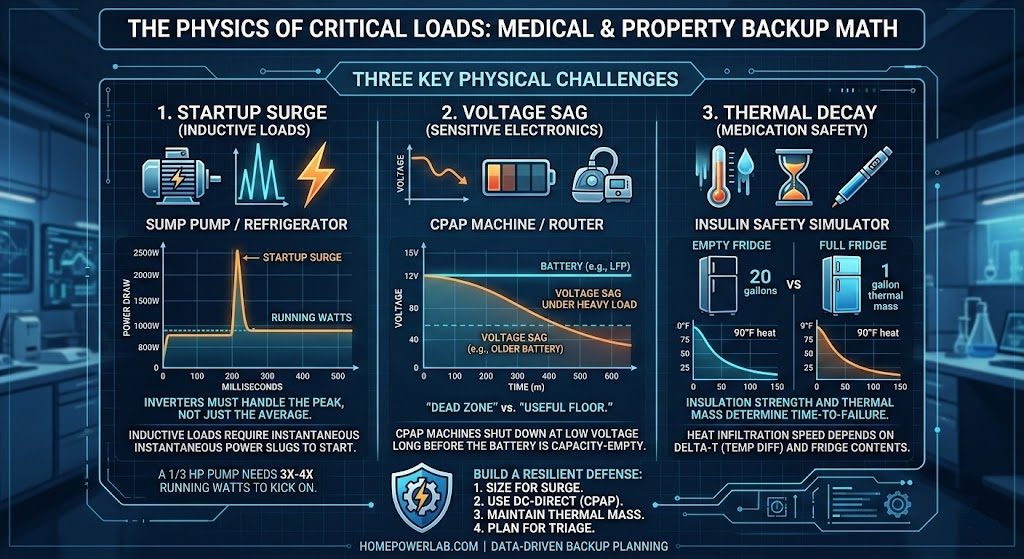
This report examines the hidden physics behind powering critical loads during outages. While most backup power guides focus on wattage labels, real-world failures often occur due to three overlooked factors.
- Startup Surge – motors can draw 3–6× running power
- Voltage Sag – battery output drops under heavy load
- Thermal Decay – cooling systems slowly lose stability
Understanding these factors turns backup power planning from guesswork into engineering.
When the stakes involve life-critical medical equipment like CPAP machines, temperature-sensitive medications like insulin, or property-defense systems like sump pumps, “close enough” is a recipe for disaster. To build a resilient defense, we have to look at the four hidden variables that standard calculators ignore: Startup Surge, Voltage Sag, Thermal Decay, and Systemic Overhead.
⚠️ The Three Failure Modes of Backup Systems
Most backup systems fail for reasons unrelated to total battery capacity.
- Startup overload from motors and compressors
- Battery voltage collapse under high draw
- Cooling drift when refrigeration cycles slow
These failures occur even when the system technically has enough watt-hours remaining.
In This Report
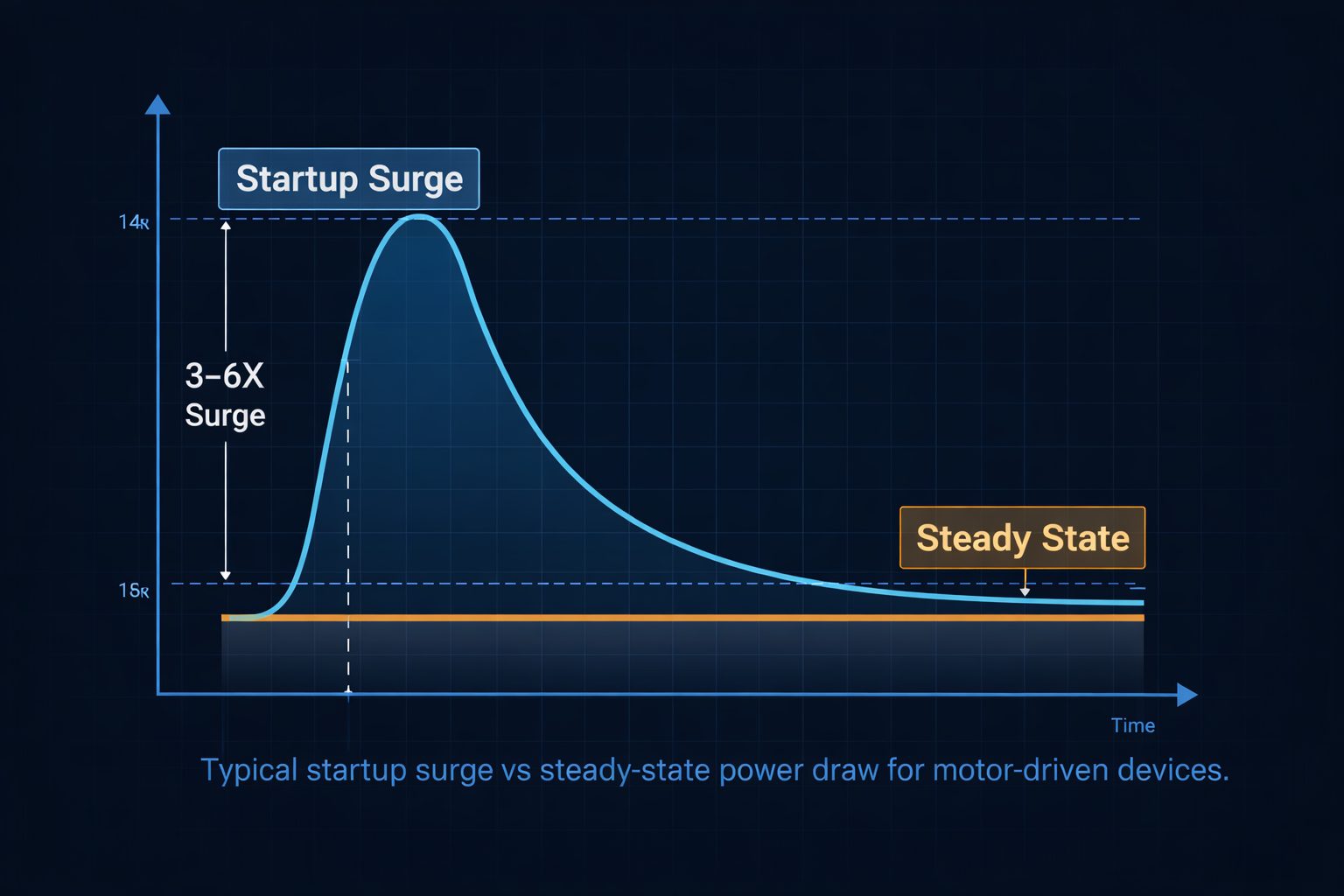
Typical startup surge vs steady-state power draw for motor-driven devices.
The Surge Barrier: Startup Surge vs. Running Watts
The most common mistake in backup planning is confusing running wattage with inrush current (startup wattage). Most electrical devices with compressors or motors—sump pumps, refrigerators, and some medical devices—require a massive “slug” of energy to transition from a standstill to an active state.
A standard 1/3 HP sump pump might only draw 800 Watts while running, but its inductive motor requires a startup surge of 2,500 to 3,000 Watts for a fraction of a second. This is because a motor at rest represents a near-short circuit until the rotor begins to spin and generates “Back EMF” (Electromotive Force).
If your portable power station is rated for a “2,000W Surge,” it won’t matter if the battery is 100% full; the inverter’s safety circuit will trip instantly to protect itself from the overcurrent. The pump never starts, and the basement floods.
Lab Observation: We have tested “Pro-sumer” power stations that claim 3000W surge peaks, yet fail to start a 1/2 HP pump because their peak duration is only 20 milliseconds, while the pump requires 150 milliseconds to stabilize. When sizing “Critical Load Backup Power,” you must account for the duration of the surge, not just the peak number.
Typical Surge Factors for Critical Loads
| Device | Running Power | Startup Surge | Physics Factor |
|---|---|---|---|
| Sump Pump | 800W | 2500–3000W | Inductive motor load |
| Refrigerator | 120W | 700–1200W | Compressor startup surge |
| CPAP (heated) | 60W | 60W | Resistive heating element |
| Starlink Mini | 30–40W | 40–50W | Constant electronic load |
The Sag Factor: Voltage vs. Chemical Capacity
A battery is not a fuel tank where the pressure stays constant until the last drop. In the Lab, we measure the Discharge Curve. As a battery depletes, its internal resistance increases, and the output voltage “sags.”
This is critical for medical equipment like CPAP machines. A CPAP is a precision air pump. While it may draw only 30–60 Watts, it is highly sensitive to input voltage. If you are running a 12V DC-native setup and your battery sags to 10.5V under load, the CPAP’s internal logic may trigger a “Low Power” error and shut down in the middle of the night—even if the battery still has 40% of its theoretical capacity remaining.
This “Voltage Floor” is the reason we built the CPAP Power Sizer. We don’t care how many Watt-hours are in the box; we care how many Watt-hours can be delivered at a stable voltage that keeps the machine running until morning. For medical reliability, you are only as strong as your battery’s voltage stability, not its total capacity.
🔬 Lab Tip: Run Devices DC-Direct When Possible
Many critical devices internally operate on DC power. Running them through an inverter adds conversion losses of 8–15%.
In our lab testing, running devices directly from 12V or USB-C PD sources often extended runtime significantly.
- Starlink Mini – USB-C PD adapter
- CPAP machines – 12V DC adapter cables
- Portable routers – USB power
By bypassing the inverter entirely, these devices can sometimes run nearly twice as long on the same battery.
Thermal Decay: The Physics of Insulin Safety
For medication safety, the enemy isn’t just the loss of power; it’s the Second Law of Thermodynamics. When the grid goes down, your refrigerator becomes a “passive thermal mass.” Most “Insulin Safety” advice tells you to “keep the door closed.” Our Thermal Defense Simulator takes it further by modeling the rate of heat transfer, governed by Newton’s Law of Cooling:
$$\frac{dT}{dt} = -k(T(t) – T_s)$$
(Where $T$ is the temperature of the insulin, and $T_s$ is the ambient temperature of the room).
The speed at which your medication reaches the critical “failure temperature” (usually above 86°F/30°C for most modern insulins) is determined by the Delta-T (the difference between the room temperature and the fridge temperature) and the specific heat capacity of the contents inside.
If your kitchen is 90°F during a summer outage, a half-empty refrigerator will lose its safety margin much faster than a full one. This is because a full fridge has more “Thermal Mass”—it takes more energy to move the temperature of 20 gallons of water than 1 gallon of air. We test these “time-to-failure” curves so that homeowners know exactly when to transition from “Passive Cooling” to “Active Cooling,” such as moving meds to a dedicated 12V-powered travel cooler.
Systemic Overhead: The “Hidden” Drain
Every backup system has a “cost of doing business” known as Parasitic Load. If you turn on a 2,000W inverter to power a 10W phone charger, the inverter itself may be pulling 30W–50W just to keep its internal circuits energized and its fans spinning. This is known as Inverter Idle Draw.
In a critical load scenario, this overhead can be lethal to your plan. If you are trying to keep a medical fridge running overnight and the fridge cycles on for only 10 minutes every hour, a poorly designed inverter will stay “ON” for the other 50 minutes, slowly draining the battery while doing no work.
The Lab Rule: For long-term endurance, your goal is to minimize the Idle Draw-to-Load Draw ratio. This is why we advocate for DC-Direct connections for devices like the Starlink Mini or CPAP machines—bypassing the inverter entirely can often double your usable runtime.
Typical Inverter System Overhead
| Inverter Size | Typical Idle Draw | 24-Hour Battery Cost | Hidden Physics |
|---|---|---|---|
| 500W Portable | 6–10W | 144–240Wh | Small inverter electronics overhead |
| 2000W Power Station | 20–35W | 480–840Wh | Cooling fans + inverter conversion losses |
| 3000W Inverter | 40–70W | 960–1680Wh | Large inverter switching losses |
Even when powering nothing, large inverters consume energy simply staying active. This background draw can quietly drain an entire battery over a long outage.
The Sump Pump Hydrograph: Timing the Failure
Property defense isn’t just about power; it’s about the Infiltration Rate. During a heavy storm, water enters a sump pit at a specific rate (the hydrograph). If your pump cycles every 2 minutes and runs for 15 seconds, your battery endurance is significantly lower than if it cycles every 10 minutes.
Why? Because sump pumps cycle repeatedly during heavy rain events, every startup becomes a high-stress event for the inverter and battery. Systems that appear adequately sized on paper can fail after only a few cycles if the inverter cannot handle the repeated surge events. At Home Power Lab, we simulate “Storm Stress” by modeling these frequent cycles. Our Basement Defender Simulator reveals that most “12V Backup Sump” systems fail not because the battery is empty, but because the frequent surges cause the battery voltage to “sag” below the pump’s minimum operating threshold during the peak of the storm.
🔬 Tools That Apply This Physics
If you’re calculating backup systems, these tools help visualize the concepts discussed in this report.
Physics-Based Solutions
Understanding why systems fail leads to better equipment choices. The most reliable backup systems address the three failure modes discussed in this report.
- High Surge Inverters – systems capable of delivering 2–3× surge for 100–300ms handle inductive loads like pumps and compressors.
- Stable Voltage Batteries – high-quality LiFePO4 batteries maintain a flatter discharge curve, reducing voltage sag during heavy loads.
- DC-Direct Operation – devices like CPAP machines and Starlink Mini can often run directly from DC power, bypassing inverter losses entirely.
Designing around these principles often extends runtime dramatically compared to simply buying a larger battery.
Conclusion: Preparedness is Clarity
The goal of the HomePowerLab is to replace anxiety with data. Whether you are protecting your health or your home, the math of a 72-hour outage is unforgiving. By understanding that Startup Surge is a barrier, Voltage Sag is a limit, Thermal Decay is a clock, and Systemic Overhead is a leak, you can move beyond “marketing math” and build a backup plan that actually holds when the grid goes dark.
Critical Load Physics FAQ
What is a critical load in backup power planning?
A critical load is any device that must continue operating during a power outage. Examples include medical equipment, sump pumps, refrigerators, communication systems, and heating devices.
Why do devices fail even when the battery still has power?
Many failures occur because of startup surge, voltage sag, or inverter limits rather than battery capacity. A device may require more power at startup than the inverter can deliver.
Why do refrigerators and pumps cause backup systems to trip?
Motor-driven devices briefly draw several times their running wattage when starting. If the inverter cannot deliver that surge, the system shuts down even if the battery has plenty of charge.

Leave a Reply
You must be logged in to post a comment.