
What this plan is (and what it is not)
- This is energy triage. We prioritize food safety, communications, and critical health/heating needs under real constraints.
- This is not “whole-home backup.” Most portable systems fail when treated like a panel replacement. A 72-hour plan is selective.
- This assumes bad weather. Outages often coincide with cloud cover, cold, or extreme heat. Best-case solar math breaks plans.
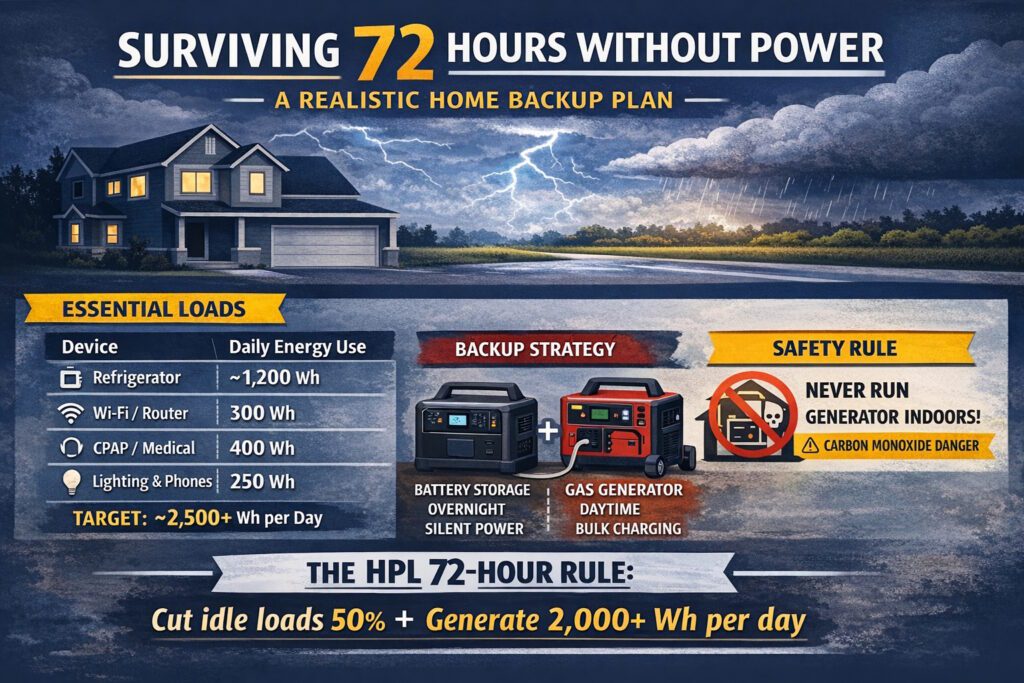
Cut idle loads by ~50%
+
Replace ~2,000–3,000 Wh per day (generator or realistic solar)
This is where most plans fail: conversion losses, surge events, weather, and thin margins.
A 72-hour power outage plan sounds straightforward—until it fails.
A homeowner buys a “2,000W solar generator.” The box promises whole-home backup. The refrigerator hums during a test run. Phones charge. Confidence builds.
Twelve hours into a real outage, the battery is empty. The panels underperform in heavy cloud cover. The refrigerator compressor trips the inverter on a restart surge. The well pump never even comes online.
Nothing was defective. The system did exactly what it was built to do. The plan failed because it was sized for marketing math rather than real-world energy flow.
This guide focuses on energy triage, not gear accumulation. The goal is simple: build a 72-hour power-outage plan that withstands weather, surge loads, human behavior, and imperfect assumptions.
Creating a 72-Hour Power Outage Plan? Start Here
HPL Quick Brief: The 72-Hour Rule of Thumb
The HPL 72-Hour Rule:
To get through three days without grid power, you do not need the largest battery available. You need:
- Idle loads reduced by at least 50%
- A realistic daily energy budget (measured, not guessed)
- A way to generate or refuel roughly 2,000Wh–3,000Wh of replacement energy per day
Most failures stem from ignoring one of those three.
Why the 72 Hour Power Outage Plan Is Commonly Misunderstood
Watts vs. Watt-Hours: The Core Confusion
Manufacturers advertise peak output (e.g., 2,000W). Consumers interpret that as endurance.
- Watts (W) = how much power can flow at one moment
- Watt-hours (Wh) = how much energy is stored over time
A 2,000W inverter paired with a 1,000Wh battery can run a 100W device for about 10 hours under ideal conditions—not three days.
Output capacity and stored energy are different constraints. Both matter.
Runtime Claims Assume Ideal Conditions
Product runtime charts often assume:
- Constant load
- No surge events
- No inverter idle draw
- No temperature derating
- Perfect solar conditions
Homes do not behave like laboratory resistors.
Refrigerators cycle. Compressors surge. Inverters consume power even when lightly loaded. Batteries lose efficiency in cold weather.
Marketing simplifies. Physics does not.
How a 72 Hour Power Outage Plan Actually Works
Energy flows through a chain:
Source → Charge Controller → Battery → Inverter → Loads
Each stage introduces loss and limits.
Step 1: Build a Measured Daily Energy Budget
During a 72-hour power outage plan, comfort is secondary. Preservation and safety come first.
Below is a realistic baseline for essential loads in a modest home:
| Device | Average Draw | Daily Runtime | Approx. Daily Energy |
|---|---|---|---|
| Refrigerator | 100–150W cycling | 24h | 1,000–1,500Wh |
| Freezer | 80–120W cycling | 24h | 800–1,200Wh |
| LED lighting (4 bulbs) | 40W | 6h | 240Wh |
| Router + modem | 10–20W | 24h | 240–480Wh |
| Phone charging | 10W | 4h | 40Wh |
| Laptop | 60W | 3h | 180Wh |
A realistic essential load budget:
2,000–3,000Wh per day
For three days:
2,500Wh × 3 = 7,500Wh
Now account for inverter losses (roughly 10–15%, depending on model).
7,500Wh ÷ 0.88 ≈ 8,500Wh
(The division accounts for the ~12% energy lost when converting DC battery power to AC wall power.)
That exceeds the capacity of most single portable power stations.
Test your 72-hour power assumptions
This calculator converts your estimated daily loads into a three-day energy target. Adjust refrigerator usage, inverter losses, and replacement power to see whether your plan survives real-world conditions.
The “Hidden” Essentials Most Plans Miss
A 72-hour power outage plan often fails because of overlooked loads.
Well Pumps
If you are on a private well:
- Startup surge often exceeds 2,000W
- Running draw may be 800–1,200W
- Many portable battery systems will trip
No water means no toilets, no washing, no cooking.
Furnace Igniters and Blowers
Gas furnaces still require electricity:
- Igniter
- Control board
- Blower motor
Combined draw can range from 400–800W, with higher startup surge.
CPAP Machines
Medical devices are not optional loads. Many draw 30–60W continuously overnight.
Electric Water Heaters
Standard electric water heaters draw 4,000–5,000W. They are generally incompatible with portable backup systems.
If you rely on city water, you may still lose hot water.
72-hour triage: what to secure first
- 1) Refrigeration and food safety Measure refrigerator/freezer watt-hours per day with a plug-in meter. Assume higher cycling in heat and after door openings.
- 2) Water (if you’re on a well) Confirm pump surge requirements and whether your inverter can start it. If not, plan water storage before the outage.
- 3) Heat/cooling risk reduction Do not assume batteries can “buy heat” or “buy AC” for days. Use thermal strategy: layers, room isolation, shade, ventilation.
- 4) Communications and medical loads Router/modem, phone charging, CPAP, and medical devices often matter more than convenience loads.
The Climate Variable: February Is Not July
A 72-hour power outage plan must account for the season.
Summer Risks
- Refrigerators run longer cycles
- Freezers cycle more frequently
- Air conditioning becomes tempting but often unrealistic
A 1,500W space heater or portable AC unit will drain a 2,000Wh battery in little more than an hour.
Winter Risks
- Battery performance declines in cold weather
- Solar panels may be snow-covered
- Heating loads become critical
Lithium batteries commonly restrict charging to temperatures below freezing. Cold also reduces usable capacity.
Outages are not uniform events. Plans must reflect climate.
Solar Reality: Yield vs. Weather
Solar output is highly condition-dependent. Nameplate wattage is not real-world yield.
Example for a 400W panel array:
| Weather Condition | Real Output | 4-Hour Daily Yield |
|---|---|---|
| Clear, optimal angle | ~320W | ~1,280Wh |
| Partial cloud | ~180W | ~720Wh |
| Heavy overcast | ~40W | ~160Wh |
If your household needs 2,500 Wh of electricity daily, heavy overcast conditions make solar power unsustainable.
Design for conservative averages, not best-case days.
Real-World Constraints That Change Outcomes
Inverter Idle Draw
Many inverters consume 15–30W even when lightly loaded.
25W × 24 hours = 600Wh per day
Over three days, 1,800 Wh was lost to idle consumption.
The energy discipline often fails before the battery does.
Surge Shutdowns
Refrigerators, freezers, and pumps may surge to 2–3 times their running wattage.
If two compressors start simultaneously, the inverter may trip—even though the average load appears safe.
Fuel Consumption Reality
A 2,000W inverter generator operating at partial load may consume:
- 0.1–0.2 gallons per hour
At 12 hours per day:
- 1.2–2.4 gallons daily
- 3.6–7.2 gallons over 72 hours
Fuel is stored energy. It must be managed.
Carbon monoxide is the most preventable outage fatality
Never operate a generator inside a house, garage, basement, or near open windows/doors. Keep it at least 20 feet from the structure and direct exhaust away from living areas. Treat this as non-negotiable. Fuel adds endurance; it does not reduce risk.
The Golden Rule of Generator Safety
WARNING — Generator Operation:
Never operate a generator inside a house, garage, basement, or within 20 feet of the structure. Carbon monoxide is odorless, colorless, and lethal. Fuel provides endurance; it does not remove safety responsibility.
Carbon monoxide incidents during outages are well-documented and preventable.
What Consistently Works (and Why)
Across storm seasons and multi-day outages, several patterns hold.
1. Energy Triage
Power:
- Refrigeration
- Communications
- Medical devices
- Minimal lighting
Defer:
- Coffee makers
- Hair dryers
- Electric ovens
- Entertainment systems
Every deferred watt extends runtime.
2. Hybrid Systems
Battery + generator provides resilience.
- Battery covers overnight operation
- Generator runs in controlled intervals to recharge the battery and cool the appliances
This reduces fuel use and noise exposure.
3. Load Staggering
Do not run high-surge appliances simultaneously.
Microwave use can wait ten minutes.
4. Thermal Strategy
Keep freezer full. Add ice blocks. Limit door openings.
Cold mass reduces electrical demand.
Practical, Risk-Aware Planning Steps
Step 1: Measure, Don’t Estimate
Use a plug-in power meter on your refrigerator for 48 hours.
Record:
- Total watt-hours
- Peak surge
Base your 72-hour power outage plan on measured data.
Step 2: Calculate Your 72-Hour Energy Target
Daily measured load × 3
Add 10–15% for losses.
That is your minimum required energy.
Step 3: Reduce Idle Loads
Unplug:
- Secondary refrigerators
- Unused chargers
- Decorative lighting
- Non-essential electronics
Cutting energy consumption by 300–500 Wh per day significantly extends battery life.
Step 4: Conduct a Controlled Test
Simulate a 6-hour outage:
- Run the refrigerator from the backup
- Monitor battery drain
- Test generator recharge timing
- Observe interior temperature stability
Testing converts assumptions into data.
Failure Modes & Quiet Break Points
Most outages degrade gradually rather than fail dramatically.
- Solar yields less than expected
- Fuel runs out faster than assumed
- Batteries deplete overnight
- Surge trips interrupt refrigeration cycles
- Well pumps remain unusable
Plans fail when margins are thin.
Design with margin.
HomePowerLab Perspective
At HomePowerLab, we test backup systems under cycling compressor loads, not constant resistive heaters.
We measure:
- Inverter idle consumption
- Real delivered watt-hours vs. advertised capacity
- Surge tolerance under simultaneous cycling
- Solar recharge under partial cloud cover
- Battery performance across temperature ranges
Our consistent observation: systems rarely fail because they are defective. They fail because they were sized for averages without accounting for variability.
Energy planning is about margins, not labels.
Questions that determine whether a plan holds
How big of a battery do I need for 72 hours?
Most homes cannot run “normally” for three days on a single portable battery. A realistic approach is to cover overnight essentials with battery and replace roughly 2,000–3,000Wh per day using generator runtime or conservative solar. Start by measuring your refrigerator/freezer.
Why does my “2,000W” unit die so fast?
The watt rating describes output, not stored energy. Runtime depends on watt-hours, plus conversion losses and inverter idle draw, which can quietly consume hundreds of watt-hours per day.
Can I run a space heater or portable AC from a battery power station?
Briefly, sometimes. Reliably for multiple days, rarely. A 1,500W heater consumes roughly 1,500Wh per hour plus losses. Multi-day planning usually works better with thermal strategy than trying to power resistive heating or AC.
What breaks first in real outages?
Margins. Solar underperforms during storms, surge events trip inverters, and idle loads drain capacity. Plans that “barely work” on paper typically fail in the first 24 hours.
I’m on a well. What’s the simplest plan?
Treat water as a primary constraint. Confirm pump starting surge versus your inverter’s surge capability. If you cannot start the pump, stage water storage and consider running a generator in scheduled intervals to pump water during controlled windows.
Conclusion: Preparedness as Understanding
A realistic 72-hour power outage plan is not about accumulating more equipment. It is about understanding constraints.
Three days without grid power are manageable when:
- Essential loads are measured
- Solar expectations are conservative
- Surge loads are accounted for
- Fuel is rotated
- Systems are tested before emergencies
Preparedness is clarity.
When you understand how much energy you consume, how much you can store, and how much you can realistically generate, uncertainty shrinks.
The goal is not to power everything. It is to preserve what matters—safely, predictably, and within physical limits.
That is the difference between owning equipment and having a plan.

Leave a Reply
You must be logged in to post a comment.