
Project: The Thermodynamics of Survival – Why Your Solar Generator Can’t Run Your AC
Subject: Portable Air Conditioning Power Analysis
Date: February 24, 2026
- Will my generator survive compressor startup?
- How long will it run with duty cycle reality?
- How much solar closes the night gap?
- Select your power station (or enter Wh + inverter rating).
- Pick your AC type and confirm the startup surge estimate.
- Set a realistic duty cycle (hotter room = higher duty cycle).
- Watch for SYSTEM FAIL (surge/inverter) vs runtime limit (battery).
- Using a higher-surge station
- Switching to a smaller AC
- Pre-cooling the room to reduce cycling
In This Report
Executive Summary
The portable power industry is rife with a specific marketing deception: the implication that a “1000 Watt” battery can run a “1000 Watt” Air Conditioner for one hour.
This calculation is mathematically simple, intuitively appealing, and thermodynamically false.
In our testing at HomePowerLab, we have found that uninitiated users frequently purchase undersized “solar generators” (portable power stations) expecting to climate-control a tent, van, or bedroom during a grid-down scenario, only to face immediate system shutdown or dismal runtimes (often under 45 minutes).
This report details the physics engine behind our new Cooling Reality Check tool. It dissects the four “Silent Killers” of off-grid cooling: Inductive Surge, Inverter Derating, Thermal Duty Cycles, and the Solar “Night Gap.”
The Problem: The Linear Math Fallacy
The average consumer performs the following calculation: $$\text{Battery Capacity (Wh)} / \text{AC Draw (W)} = \text{Runtime (Hours)}$$
Example: A 1000Wh Jackery vs. a 1000W Portable AC. $$1000Wh / 1000W = 1 \text{ Hour}.$$
In the real world, this setup often yields 0 minutes (failure to start) or ~42 minutes (premature depletion). The linear math fails because it ignores the overhead costs of energy conversion and the mechanics of compressor motors.
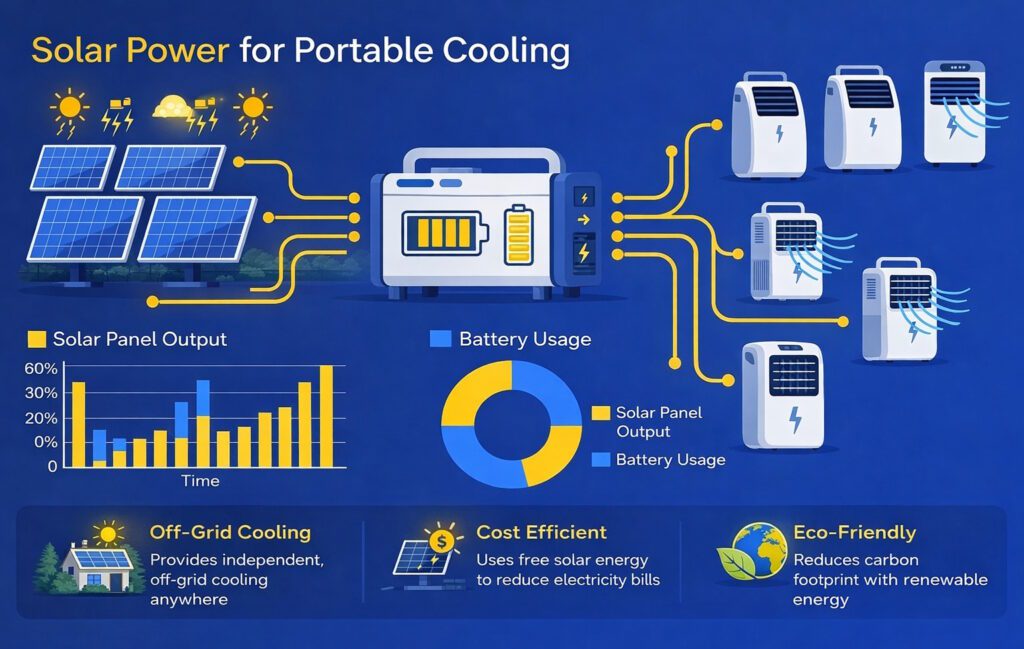
Methodology: The Physics of Failure
Our Cooling Reality Check tool does not use linear math. It uses a physics-based simulation engine that accounts for the following variables.
The Gatekeeper: Inductive Surge (LRA)
Air conditioners are not resistive loads (like a toaster or lightbulb); they are inductive loads. They use a compressor motor that requires a large energy spike to overcome static friction and pressurize the refrigerant lines. This is known as Locked Rotor Amps (LRA) or Inrush Current.
While a modern 5,000 BTU unit may run at 500 Watts, it often requires 1,500 to 2,000 Watts to start within approximately 300 milliseconds.
The Reality Check Logic: The tool implements a “Gatekeeper” check. If the user selects a battery with a 1000W continuous output (like a Jackery 1000) and attempts to run a generic 8,000 BTU AC (Running: 900W, Surge: ~2700W), the tool triggers a SYSTEM FAILURE.
The battery has the capacity (fuel) to run the AC, but it lacks the power (horsepower) to turn the engine over. The BMS (Battery Management System) detects the overcurrent and trips the safety breaker instantly.
The Inverter Tax (DC to AC Conversion)
Batteries store energy as Direct Current (DC). Air Conditioners require Alternating Current (AC). The bridge between them is the Inverter.
Inverters are not 100% efficient. Converting 12V/48V DC into 120V AC generates heat. Typical consumer-grade inverters operate at 85% efficiency.
The Equation: $$\text{Usable Energy} = \text{Total Wh} \times \text{Depth of Discharge (DoD)} \times \text{Inverter Efficiency}$$
For a generic “1000Wh” battery: $$1000 \times 0.90 (\text{DoD}) \times 0.85 (\text{Eff}) = \mathbf{765 \text{ Real Usable Watt-Hours}}$$
Before the AC even turns on, nearly 25% of the advertised capacity is lost to physics constraints and safety buffers.
The Insulation Factor (Duty Cycle)
This is the single most variable factor in off-grid cooling.
- Scenario A (The Tent): Zero insulation. The “thermal load” (sun heat) enters the space faster than the AC can remove it. The compressor runs continuously.
- Scenario B (The Bedroom): High insulation. Once the target temp is reached, the compressor turns off, leaving only the fan (20-40W) running.
The Algorithm: The tool introduces a Duty Cycle coefficient ranging from 0.5 (Bedroom) to 1.0 (Tent). $$\text{Average Watts} = \text{Peak Watts} \times \text{Duty Cycle}$$
A user in a well-insulated room effectively doubles their runtime compared to a van-lifer parked in the sun. This distinction transforms the data from “fear-mongering” to “actionable planning.”
The Solution: Solar Offset & The “Night Gap”
The most sophisticated part of the calculator is the 24-Hour Solar Simulator.
Many users assume that if they have 400W of solar panels and their AC uses 400W, they can run forever. This is false due to the “Night Gap.”
- Solar is a Bell Curve: You only get peak power for roughly 4-5 hours a day. At 9 AM and 5 PM, generation is a fraction of the rating.
- The Night Gap: From 7 PM to 7 AM, solar input is zero. The battery must bridge this 12-hour gap entirely on stored energy.
The Simulation Logic: The tool runs a loop starting at noon (Peak Sun). It calculates the Net Flow (Solar Generation – AC Consumption) in 30-minute increments.
- Daytime: Ideally,
Solar > AC, recharging the battery. - Nighttime:
Solar = 0. The battery drains.
If the battery hits 0% before 6:00 AM, the setup is deemed “Non-Viable for Autonomy.” This visually proves that for 24/7 cooling, battery capacity is often more critical than solar array size.
Case Studies & Recommendations
Based on the Cooling Reality Check data, we have identified three distinct performance tiers.
Tier 1: The Failure Zone (Portable ACs + Small Batteries)
- Gear: 8,000 BTU Single-Hose Portable AC + Bluetti EB3A / Jackery 240.
- Result: System Failure. The surge current trips the inverter immediately.
- Verdict: Do not attempt.
Tier 2: The “Emergency Only” Zone
- Gear: 5,000 BTU Window Unit + EcoFlow Delta 2 (1024Wh).
- Result: ~2 to 2.5 hours runtime.
- Verdict: Useful for cooling a room before bed to fall asleep, but the unit will die by 2 AM. Requires massive solar input to recharge the next day.
Tier 3: The “Tactical Autonomy” Zone (The Fix)
- Gear: Midea U-Shaped Inverter AC (8k BTU) + EcoFlow Delta Pro (3600Wh).
- Analysis: The Midea U is an inverter AC, meaning it has no massive startup surge (Soft Start) and can throttle its compressor down to 200W once the room is cool.
- Result: 12+ Hours Runtime (Overnight). With 800W of solar, this system can run indefinitely in a moderate climate.
FAQ: Solar Generators + Portable AC
Can solar panels run a portable AC directly?
Why does my power station say it can handle the watts, but still fails?
What duty cycle should I use?
What’s the “night gap” and why does it matter?
Conclusion
The physics of cooling are unforgiving. To run an air conditioner off-grid, you cannot rely solely on the sticker wattage. You must account for your inverter’s surge capability, conversion efficiency losses, and the thermal properties of your shelter.
The Cooling Reality Check tool was built to provide this transparency. It moves users away from the dangerous assumption of linear math and towards a robust, engineered power strategy.
Final Recommendation: Stop buying bigger batteries to power inefficient ACs. Buy a more efficient AC (Inverter-based) to fit your existing battery.
Lab Report generated by HomePowerLab Engineering Team.
Portable AC vs. Solar Generator: The Physics of Cooling
A deep-dive engineering analysis on why most portable batteries fail to run air conditioners. We break down surge currents, inverter efficiency, and the "Night Gap" to calculate real-world runtime.
Price: 0.00
Operating System: web
Application Category: UtilitiesApplication