
Project: The Thermodynamics of Crypto-Heating
Subject: Residential Energy Efficiency / Cryptocurrency Mining
Date: March 21, 2026
ASIC heat recovery can be technically valid, but it is not a blanket replacement for a heat pump.
If your goal is lowest-cost delivered heat, a modern heat pump usually wins because it multiplies each unit of electricity into several units of heat. If your goal is heating plus Bitcoin revenue, an ASIC can partially offset its operating cost by turning nearly all electrical input into usable heat while also producing digital output.
The real question is not “Does an ASIC make heat?” It absolutely does. The real question is: how much does that heat effectively cost after mining revenue, duty cycle, climate, electricity price, and hardware risk are included?
- Cold season with steady heating demand
- Relatively low power cost
- Hardware already owned or cheaply sourced
- User accepts noise, maintenance, and mining risk
- Primary goal is efficient home heating
- Stable long-term operating economics matter most
- Noise and livability matter
- User wants predictable performance with minimal tinkering
- ASICs are not “free heat”
- They are a special-case heat source with a financial sidecar
- Heat pumps remain the efficiency benchmark
- The calculator below helps find the break-even zone
Quick Test Scenario (Try This First)
Before running your own numbers, plug in this baseline scenario to see how the model behaves. This demonstrates the “break-even zone” described in the lab report.
- Electricity Cost: $0.10 per kWh
- Heat Pump COP: 3.5
- Winter Duration: 5 months
- ASIC Runtime: Continuous
Run the Crypto-Heat Auditor
Use this model to calculate your real-world break-even point. Adjust electricity cost, mining output, and runtime to see when ASIC heat shifts from liability to asset.
In This Crypto-Heat Auditor Report
Analyzing the Economic Viability of ASIC Waste Heat Recovery vs. Traditional HVAC
Executive Summary
The concept of using cryptocurrency mining hardware—specifically Application-Specific Integrated Circuits (ASICs)—as a primary heat source has transitioned from a niche hobbyist experiment to a legitimate energy strategy. However, the economic viability of this strategy is often obscured by volatile asset prices and a misunderstanding of thermodynamic efficiency.
This report details the logic and methodology behind the Crypto-Heat Energy Auditor, a new analytical tool developed by Home Power Lab. Unlike standard mining calculators, which view electricity strictly as an expense (OPEX), this auditor treats electricity as a dual-purpose utility: generating both cryptographic proofs (revenue) and thermal energy (utility).
Our analysis determines that under specific “Gold Zone” conditions—defined by electricity rates, heating utilization, and network difficulty—an ASIC miner can mathematically outperform high-efficiency heat pumps, effectively creating a heating system with a negative operating cost.
The Physics of “Waste” Heat
To understand the Auditor’s logic, we must first establish the thermodynamic baseline. A common misconception is that computers “waste” energy as heat. In reality, according to the First Law of Thermodynamics, energy is conserved.
For a silicon-based processor, nearly 100% of the electrical energy consumed is dissipated as heat. The computation itself—the flipping of bits—does not “store” energy. Therefore, a 3,000-watt ASIC miner behaves exactly like a 3,000-watt resistive space heater.
The Golden Rule of Resistive Heating: $$1 \text{ Watt-hour (Wh)} \approx 3.412 \text{ BTUs}$$
An Antminer S19 Pro consuming 3,250 Watts is not just a mining device; it is an 11,000 BTU/hr heater. From a thermal perspective, it is indistinguishable from a standard electric baseboard heater. The distinction lies entirely in the byproduct: the heater produces nothing but heat; the miner produces heat plus SHA-256 hashes.
Heating Logic Comparison: ASIC vs. Resistance Heat vs. Heat Pump
This is the core frame for the whole article: all three consume electricity, but they convert that electricity into useful household value in very different ways.
| Heating Option | Useful Heat Output | Operating Logic | Main Advantage | Main Drawback |
|---|---|---|---|---|
| Electric resistance heater | About 1 unit of heat per 1 unit of electricity | Simple direct conversion of electricity into heat | Cheap, simple, predictable | No efficiency multiplier and no side revenue |
| ASIC miner used for space heating | Nearly all input energy eventually becomes heat indoors | Produces heat as a byproduct while also generating mining revenue | Can offset effective heating cost under specific conditions | Noise, hardware wear, network difficulty, and revenue volatility |
| Heat pump | Often multiple units of heat per unit of electricity | Moves heat instead of creating all of it from scratch | Usually the efficiency king for household heating | Performance depends on climate, install quality, and equipment type |
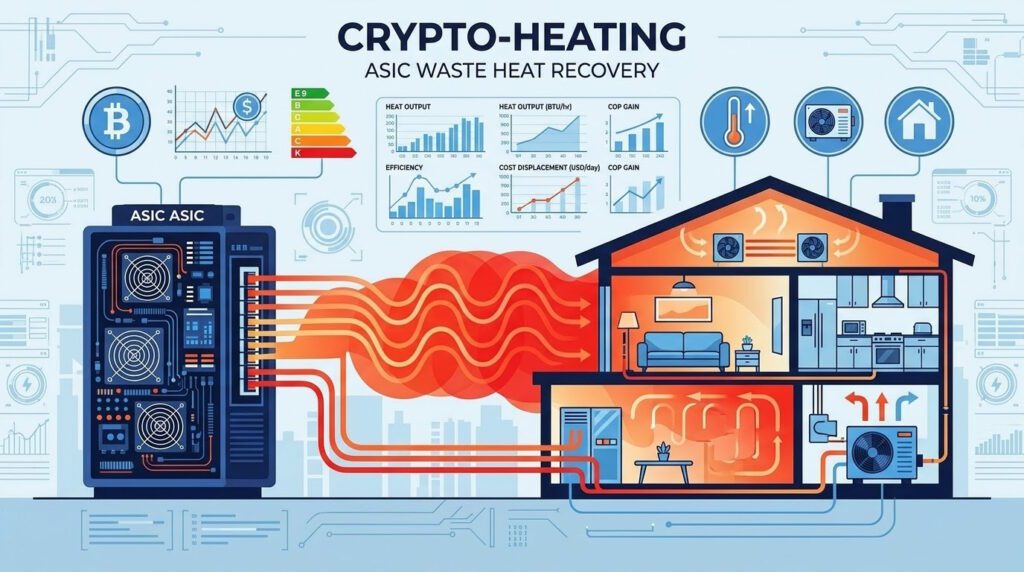
Simplified model: electrical input → ASIC → heat output + mining revenue. Unlike heat pumps, no external heat is captured—only converted.
The “Effective Cost” Methodology
Standard ROI calculators fail for residential miners because they ignore the displaced cost of the heating fuel. If a homeowner lives in a cold climate, they must purchase heat. Whether that heat comes from Natural Gas, Propane, or an ASIC is an economic choice, not just a mining operational expense.
The Crypto-Heat Energy Auditor utilizes the “Effective Heating Cost” formula:$$\text{Effective Cost} = \text{Cost}_{\text{elec}} – (\text{Revenue}_{\text{crypto}} + \text{Savings}_{\text{heat}})$$
Where:
- Cost_elec: The raw electricity bill for the miner.
- Revenue_crypto: The daily yield of Bitcoin or Kaspa.
- Savings_heat: The monetary value of the fuel not burned by the primary furnace.
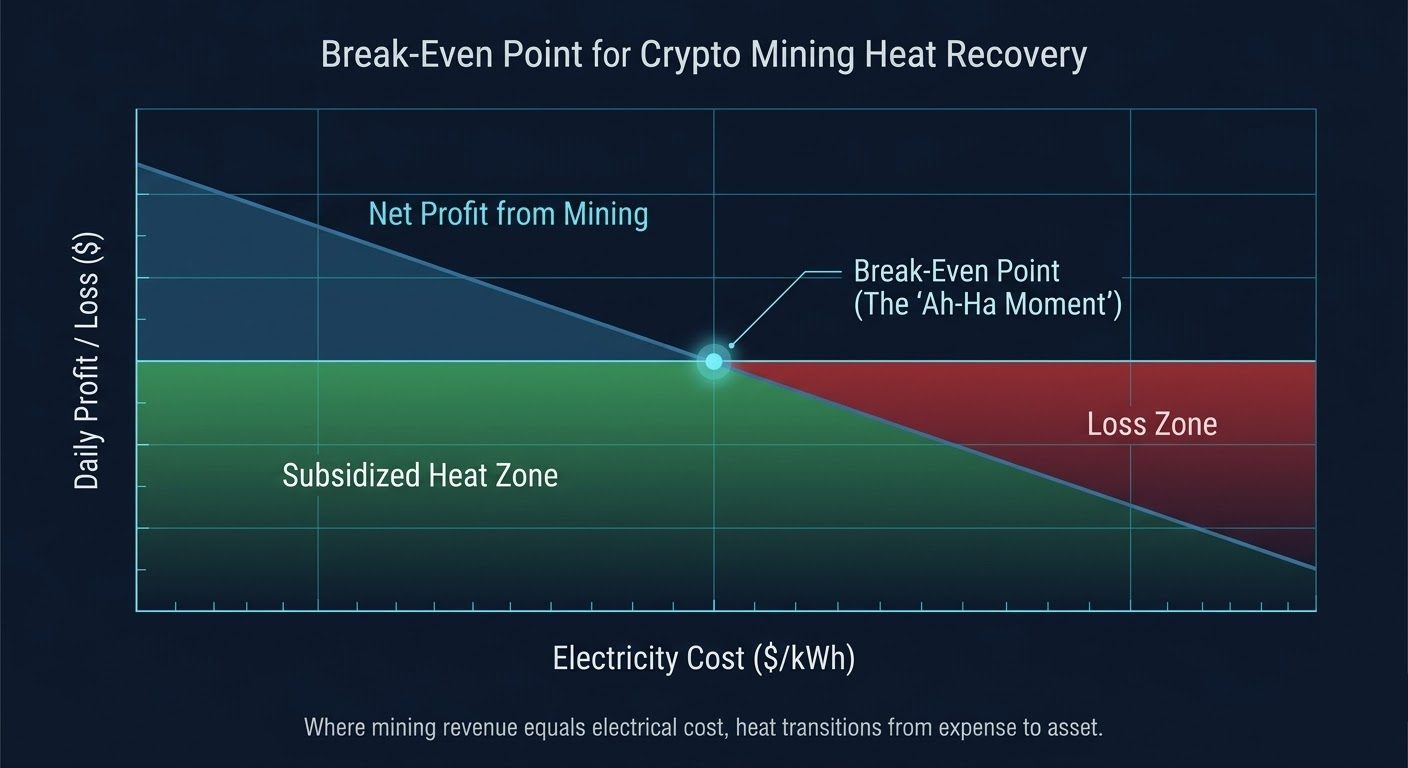
This is the “Ah-Ha” moment: the point where mining revenue offsets electrical cost. Everything above this line is a loss. Everything below it begins to behave like subsidized heat.
The Utilization Factor
A critical variable often overlooked is Seasonality. A miner running in July is a liability (due to increased AC loads). A miner running in January is an asset. The Auditor includes a Heating Utilization variable to account for real-world inefficiencies, such as ducting losses or the 24/7 operation of miners vs. the intermittent duty cycle of a thermostat.
The “Heat Pump Rivalry” (COP Analysis)
The most rigorous challenge to crypto-heating is the modern Heat Pump. Unlike resistive heaters (Coefficient of Performance, or COP = 1.0), heat pumps move heat rather than creating it, achieving COPs of 3.0 to 4.5. This means for every 1 kWh of electricity consumed, a heat pump delivers 3-4 kWh of heat.
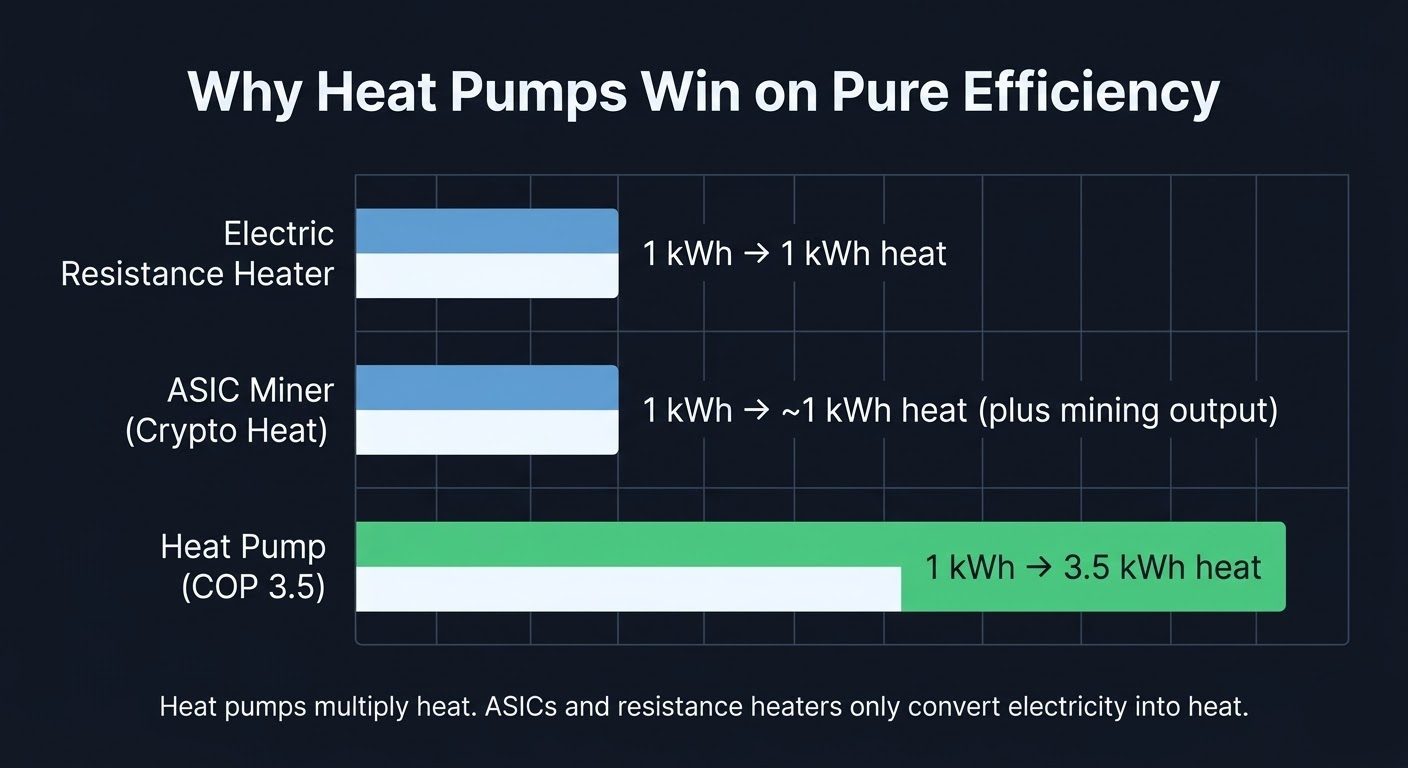
This is the physical reality behind the rivalry: resistance heaters and ASIC miners mostly convert electricity into heat at roughly a 1:1 relationship, while a heat pump can move several units of heat for each unit of electricity consumed.
Heat pumps win on pure thermodynamics. Resistance heaters and ASIC miners convert electricity into heat at roughly a 1:1 ratio, while a heat pump multiplies that energy by moving heat instead of creating it. This is the efficiency gap crypto-heating must overcome.
The Engineering Challenge: For a miner (COP 1.0) to beat a Heat Pump (COP 3.5), the crypto revenue must essentially subsidize the efficiency gap.
The Auditor calculates the “Heat Pump Beat Price”—the specific Bitcoin price at which the miner’s revenue bridges the gap between its 1:1 efficiency and the Heat Pump’s 1:3.5 efficiency.
- Scenario A (Low Rates): At $0.08/kWh, the miner’s “inefficiency” is cheap to fund.
- Scenario B (High Rates): At $0.25/kWh, the Heat Pump’s efficiency usually wins unless Bitcoin enters a bull market.
The tool visualizes this rivalry dynamically, allowing users to input their specific Heat Pump COP to see if their ASIC is a viable competitor or merely an expensive heater.
Live Network Variables & Sensitivity
Static calculators are dangerous in the crypto ecosystem. A profitability estimate based on last month’s Difficulty or Block Reward can lead to disastrous hardware investments.
The HomePowerLab Auditor integrates real-time API feeds from Mempool.space and CoinGecko. This ensures that the “Revenue” variable in our equation reflects the current harsh reality of the network’s hash rate, rather than a best-case historical average.
Sensitivity Analysis: The tool generates a Break-Even Sensitivity Chart plotting Profit vs. Electricity Rate. This visualization is crucial for determining the “Crypto-Heat Zone”—the specific range of electricity rates at which the hardware is profitable solely due to the heating offset.
Who this analysis helps — and who should probably ignore it
- You already understand basic mining economics or want to test a real-world “waste heat” scenario.
- You are comparing delivered heat cost, not just hardware specs.
- You want to know whether mining heat makes sense in a cold-season, high-runtime environment.
- You are willing to factor in noise, wear, duty cycle, and revenue volatility.
- You simply want the easiest, quietest, most efficient household heating solution.
- You are looking for “free heat” without tradeoffs.
- You do not want maintenance, fan noise, or mining-market exposure.
- You want a clean plug-and-play answer rather than a conditional engineering decision.
Conclusion: The “Infinite Glitch”
When the variables align—typically in regions with moderate electricity costs and high heating needs—the Effective Electricity Rate can drop below zero. We refer to this in the lab report as the “Infinite Glitch.”
In this state, the homeowner is effectively being paid to heat their home. While the raw mining profit might be marginal ($1-2/day), the Net Benefit (Profit + $5/day in saved gas) fundamentally changes the hardware’s ROI calculation.
The Crypto-Heat Energy Auditor is designed to find these specific edge cases. It moves the conversation from “How much money will this miner make?” to “How much will this miner reduce my living expenses?”—a far more stable and sustainable metric for the home energy enthusiast.
Terminology & Key Concepts:
- Joules per Terahash (J/TH): The efficiency of the mining machine.
- Thermal Displacement: Replacing a primary heat source with a secondary process.
- COP (Coefficient of Performance): Ratio of useful heat to work (electricity) input.
- PDU (Power Distribution Unit): Essential safety gear for running high-amperage continuous loads like ASICs.
Crypto-Heat Auditor FAQ
Is ASIC heat “100% efficient” as a heater?
Why can a heat pump still beat a miner if both use electricity?
When does ASIC heating make the most sense?
What does this article mean by “effective heat cost”?
Can mining heat replace a whole-home HVAC system?
What is the biggest mistake people make with this topic?
Run Another Home Power Lab Check
If this article changed how you think about “waste heat,” keep going. These tools help quantify the other hidden costs that wreck real-world energy setups.
Crypto-Heat Auditor: ASIC Mining vs. Heat Pumps Lab Report
Discover the economics of crypto heating. Our lab report analyzes ASIC waste heat recovery vs. heat pumps to see if Bitcoin mining can lower your winter energy bills.
Price: 0.00
Operating System: web
Application Category: UtilitiesApplication