
A Real-World Failure That Keeps Repeating
The most common backup-power failure we see is not dramatic. There’s no fire, no blown fuse, no obvious mistake. The lights stay on for a while. Phones charge. A refrigerator hums reassuringly.
Then, twelve hours later, the battery is empty.
The homeowner didn’t do anything reckless. They bought a reputable portable power station. They checked the watt rating. They believed they were “covered.” What failed wasn’t the hardware — it was the plan.
Blackout quick-start checklist
- Disconnect Tier 3 devices immediately.
- Check battery percentage and current load.
- Estimate remaining hours (Wh ÷ W).
- Lock in Tier 1 loads before adding anything else.
- Re-check usage every few hours as behavior changes.
In post-outage interviews and lab reconstructions, the pattern is consistent: people back up the wrong things first, underestimate energy draw over time, and overestimate what batteries are meant to carry. The result is a system that works just long enough to create false confidence, then quietly collapses when it’s needed most.
This article exists to prevent that outcome. Not by recommending products, but by clarifying home backup power priorities — what actually deserves battery power, what usually doesn’t, and why these distinctions matter under real stress.
In This Guide
Why This Is Commonly Misunderstood
The confusion around home backup power is structural, not personal.
Three forces distort understanding:
1. Power Is Marketed as Capability, Not Duration
Battery systems are sold by wattage (“2000W output”) and peak capacity (“2 kWh!”). Those numbers sound definitive, but they say little about how long the system can sustain useful work. Duration is the limiting factor in outages, yet it’s rarely emphasized.
2. “Whole-Home” Language Masks Tradeoffs
The phrase “whole-home backup” implies universality. In reality, nearly all battery systems require selective load planning. Without explicit prioritization, users assume everything is equally supportable.
3. Grid Thinking Doesn’t Translate
On grid power, marginal loads don’t matter. Leave a TV on overnight? Irrelevant. In backup mode, those habits quietly dominate energy use. People apply grid logic to an off-grid constraint without realizing the mismatch.
None of this is user error. It’s a planning failure driven by incomplete mental models.
How the System Actually Works
Backup power is not about wattage. It is about energy flow over time, conversion losses, and load hierarchy.
Energy Is a Finite Reservoir
A battery stores a fixed amount of energy, measured in watt-hours (Wh). Once spent, it is gone until replenished.
A 2,000 Wh battery can:
- Run a 100 W load for ~20 hours
- Or a 500 W load for ~4 hours
- Or a 1,500 W load for ~1.3 hours
That math is unavoidable.
Conversion Losses Matter
Most home devices run on AC power. Batteries store DC. The inverter that converts DC to AC typically loses 8–15% of energy. Devices with their own power bricks may reconvert AC back to DC, adding more loss.
The energy you use is always less than the energy you store.
Power vs. Energy: The Key Distinction
- Power (watts) determines whether something can run
- Energy (watt-hours) determines how long it can run
Backup failures happen when planning stops at the power.
The comfort trap: one small choice, a big runtime penalty
Heat-making appliances often look “short use” on paper. The battery does not care. It only sees watt-hours.
Real-World Conditions That Change Outcomes
Laboratory math assumes ideal conditions. Outages are not ideal.
Temperature
Cold reduces battery capacity — sometimes by 10–30%, depending on chemistry and exposure. Garages, sheds, and basements often sit below lab conditions.
Weather
Storm outages usually coincide with cloud cover, reducing solar replenishment. Heat waves increase refrigeration load while reducing charging efficiency.
Load Variability
Devices do not draw constant power. Refrigerators cycle. Sump pumps surge. Medical devices may spike during startup or recalibration.
Startup Surges
Motors can briefly draw 2–6× their running wattage. Systems sized “just enough” on paper may trip unexpectedly in practice.
For example, a refrigerator that averages 100–150W can briefly spike to 500–700W every time the compressor starts—enough to trip smaller inverters when combined with other loads.
Human Behavior
During outages, people cluster in lit rooms, open refrigerators more often, and rely on electronics for information. Load profiles change precisely when margins are smallest.
Failure Modes & Edge Cases
Quiet failure checklist: the assumptions that break first
If your plan depends on any of these, test it before you need it.
- Inverter overhead: AC output costs energy even when loads are small.
- Pass-through optimism: “Charging while running” often reduces net output stability.
- Startup surges: compressors and motors can trip systems that “should” handle the wattage.
- Hidden parasitic loads: displays, fans, adapters, and networking gear add up over long outages.
- Cold capacity loss: batteries deliver less usable energy in garages, sheds, and winter storms.
- Human behavior: people turn on “just one more thing” when stress and boredom hit.
Backup systems usually fail quietly.
The “It Was Working Fine” Collapse
A system that runs everything initially but drains too fast creates the illusion of adequacy. By the time the failure is obvious, energy is already spent.
The Inverter Ceiling Trap (The Bottleneck That Kills Full Batteries)
A battery with ample energy but limited inverter capacity may refuse to run critical devices simultaneously, forcing manual juggling under stress.
A battery can be 100% full and still shut down instantly if the inverter is overloaded. This is not a capacity failure—it is a power bottleneck.
For example: running a microwave (~1,200W) and a sump pump (~800W startup surge) at the same time can exceed a 2,000W inverter even with plenty of energy remaining.
The Pass-Through Assumption
Some systems consume power simply by being on. Displays, idle inverters, and network features add parasitic drain that rarely appears in planning math.
Solar Overconfidence
Small solar arrays are often insufficient to offset real-world loads, especially during multi-day outages. Recharging is slower than expected, and losses compound.
Solar planning rule of thumb
For outage planning, assume you will harvest ~50% of your panel’s rated wattage for about 4 effective hours per day.
Cloud cover, winter sun angle, inverter losses, and charging overhead compound quickly. If your plan only works at nameplate output, it will fail under real conditions.
What Consistently Works (and Why)
Across hundreds of simulations and field tests, the same principles hold.
Tiered Load Planning Beats Raw Capacity
Systems that succeed assign loads to priority tiers and enforce those boundaries strictly.
Fewer Loads, Longer Stability
Reducing the number of supported devices often extends usable backup time, more than doubling battery capacity.
DC Where Possible
Direct DC charging avoids inverter losses. Phones, laptops, lighting, and networking gear benefit disproportionately.
Manual Control Outperforms Automation
Smart systems are convenient, but during outages, manual awareness prevents waste and misallocation.
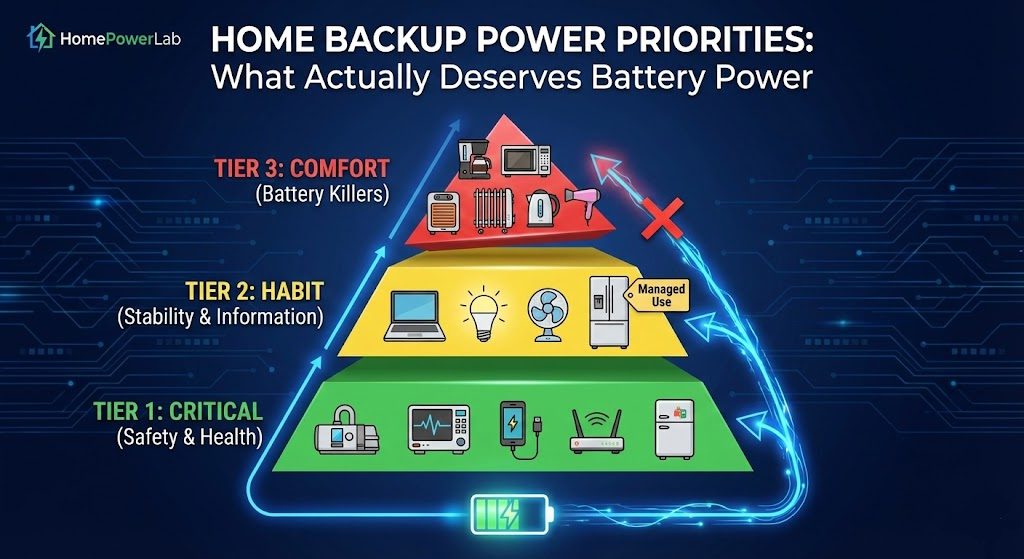
The Home Backup Power Hierarchy
Most backup failures are not caused by insufficient battery capacity. They are caused by treating all household loads as equally important when they are not.
Successful backup planning depends on sorting devices by consequence, not convenience. This hierarchy reflects how loads behave under real constraints—limited energy, imperfect conditions, and extended outages.
This hierarchy does not judge what matters to a household. It clarifies what a finite energy system can support without collapsing.
The more strictly Tier 1 loads are protected from Tier 3 demands, the longer a backup system remains reliable—regardless of battery size.
Practical, Risk-Aware Guidance
Start With Consequences, Not Devices
Ask: What happens if this is unavailable for 24 hours?
Not: Can my battery run it?
Size for Time, Not Peak
Peak wattage ensures compatibility. Energy capacity ensures survival.
Test at Home — Gently
Simulate outages during normal weather. Track energy use hourly. Note surprises.
Safety note: Do not test critical medical devices (CPAP, oxygen concentrators) as primary loads until your system has already proven stable under non-critical testing.
A safe at-home test protocol (no heroics, no rewiring)
- Pick a 2-hour window. Use normal ambient conditions. Do not wait for a storm.
- Run Tier 1 only. Phone charging, router, essential lighting, and the medical load if applicable.
- Measure battery drop. Note start and end percentage and the time elapsed.
- Add one Tier 2 load. Laptop or fan. Re-measure drop rate.
- Attempt the “trap” load briefly. If you insist on testing a microwave or coffee maker, do it for seconds, not minutes, and watch for inverter trips.
- Write the rule you learned. The output of the test should be a behavior rule, not a shopping list.
Safety note: avoid improvised household wiring, backfeeding, or any method that energizes home circuits without proper transfer equipment.
Avoid Single-Point Dependencies
A backup plan that depends on perfect weather, perfect behavior, or perfect estimates is fragile.
Treat Batteries as Bridges, Not Foundations
Batteries buy time. They do not replace fuel, grid infrastructure, or realistic expectations.
The HomePowerLab Perspective
The data behind this guide
This hierarchy is not derived from spec sheets. It comes from how consumer backup systems behave under long runtimes, mixed loads, and user-driven decision pressure. Our evaluations prioritize sustained output, conversion losses, and the kinds of quiet failures that appear only after hours of use.
- Sustained runtime under mixed loads (not just peak wattage)
- Conversion losses and idle draw across AC and DC outputs
- Cold-weather behavior when capacity and charging change materially
- Startup surge tolerance on motor and compressor loads
- Human-factor edge cases that cause planning assumptions to break
The purpose is not perfect prediction on paper. It is reliable function when conditions are imperfect and the margin for error is small.
Our conclusions consistently favor load discipline over capacity escalation. Planning clarity outperforms hardware escalation in nearly every scenario.
Tools that help validate a plan
Planning improves when you can test assumptions with numbers. These tools support the concepts in this guide.
- Battery Runtime Calculator: estimate runtime under mixed loads with conversion losses.
- Solar Reality Check: estimate refill time across seasons and realistic charging efficiency.
- Cord / Load Safety Audit: identify unsafe extension-cord and surge conditions during outages.
- Network + Router Backup Planner: measure the true draw of “small” always-on communications gear.
FAQ: Home backup power priorities
Clear answers to the questions that cause most backup plans to fail in real outages.
What are “home backup power priorities,” in practical terms?
It is a ranking of loads by consequence and energy behavior, not by convenience. A battery is a finite energy reservoir: every watt-hour spent on comfort is a watt-hour you cannot spend on safety, communications, or medical needs later. Priorities exist because outages are long, conditions are imperfect, and “everything at once” is how batteries quietly collapse.
Why can a system feel fine for hours and then fail suddenly?
Batteries rarely fail in a dramatic way. They fail by depletion. Early in an outage, people run mixed loads, the battery percentage drops faster than expected, and the system crosses a threshold where the inverter can no longer support surges or sustained draw. It often looks like “it was working,” until one more load or one more surge triggers a shutdown.
Do I need to run my whole refrigerator during an outage?
Not always. Refrigeration is important, but backup planning is about what you can sustain. A small medication fridge or mini-fridge with stable cycling can be Tier 1. A full-size modern kitchen refrigerator can behave like Tier 2 because its cycles and surges are less predictable and its daily energy demand can be much higher. Many households do better by managing fridge time (short duty cycles) or using a smaller dedicated unit for truly critical items.
What loads are the biggest “battery killers”?
Anything that makes heat is usually expensive in watt-hours: kettles, coffee makers, toaster ovens, space heaters, hair dryers. They can drain a portable battery quickly because their power draw is high and sustained. These loads may be reasonable on a large stationary system, but on portable backup they often create the worst tradeoff: large energy cost for relatively low resilience value.
Why does AC power reduce runtime compared to DC?
Batteries store DC. When you use AC outlets, the inverter converts DC to AC and loses energy as heat. If your device then converts AC back to DC (laptop/phone chargers), you pay another conversion penalty. Using DC/USB outputs where possible reduces conversion losses and often produces meaningfully longer runtime in small systems.
How much do temperature and weather matter?
They matter because they change both capacity and load demand. Cold conditions can reduce usable battery energy. Storms often reduce solar input exactly when you want recharge. Heat waves increase fan and refrigeration duty cycles. Real planning assumes conditions are not ideal.
Is “charging while running” reliable for long outages?
Sometimes, but it is commonly overestimated. Pass-through operation can introduce overhead and instability, and solar recharge is variable. A safer mental model is: recharge helps, but do not assume it replaces what you used in real time. The plan should work if recharge is slower than expected.
What is the safest way to test my backup plan at home?
Run a controlled test window with Tier 1 loads only, measure battery drop, then add one Tier 2 load and measure again. Keep the test on plug-in devices you can directly observe. Avoid any improvised home wiring, backfeeding, or energizing circuits without proper transfer equipment. The goal is to learn your real drop rate and the loads that cause surprise surges.
How do I decide what “deserves” battery power first?
Start with a single question: What happens if this is unavailable for 24 hours? If the answer involves health, safety, emergency communication, or critical food/medication stability, it belongs at the top. If the answer is inconvenience, boredom, or comfort, it belongs lower. This keeps the plan resilient even when capacity, weather, and behavior are not perfect.
What this guide is optimizing for
This framework prioritizes reliability under constraint — not comfort, not convenience, and not theoretical maximums.
Systems that survive outages do so because their owners understand limits and manage energy deliberately.
Conclusion: Preparedness as Understanding
Preparedness is not owning more equipment. It is understanding what matters when constraints tighten.
When people fail at home backup power, it is rarely because their battery was “too small.” It is because everything was treated as equally important — and nothing actually was.
A battery is not a promise. It is a finite resource that demands prioritization.
Get that hierarchy right, and even modest systems perform reliably. Ignore it, and even large ones disappoint.
Calm preparedness comes from clarity — not capacity.

Leave a Reply
You must be logged in to post a comment.