
Real-World Problem or Failure
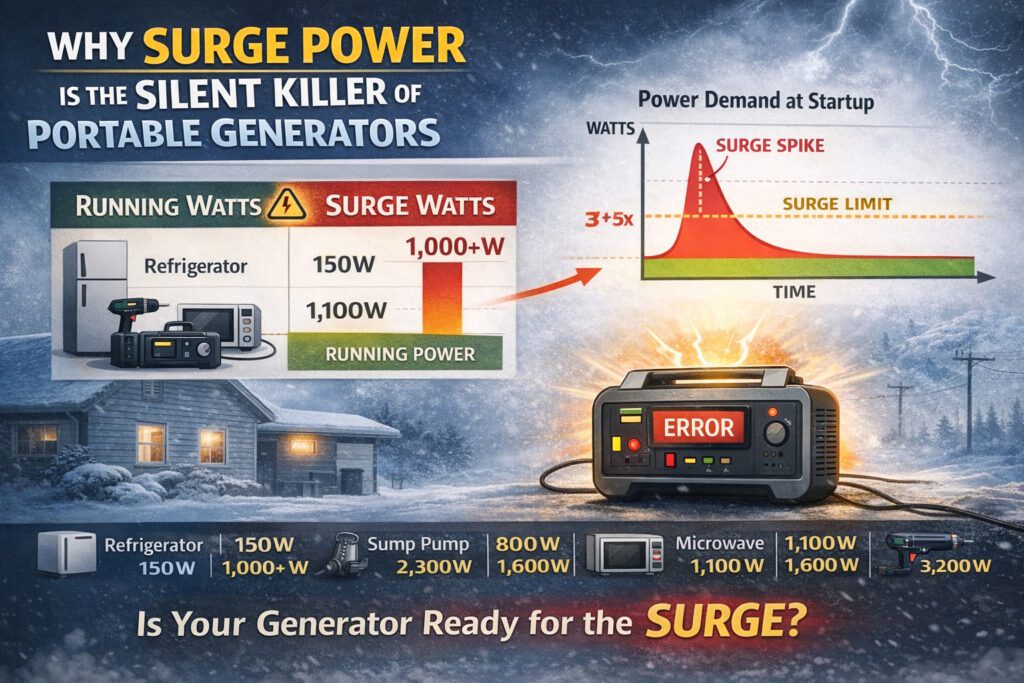
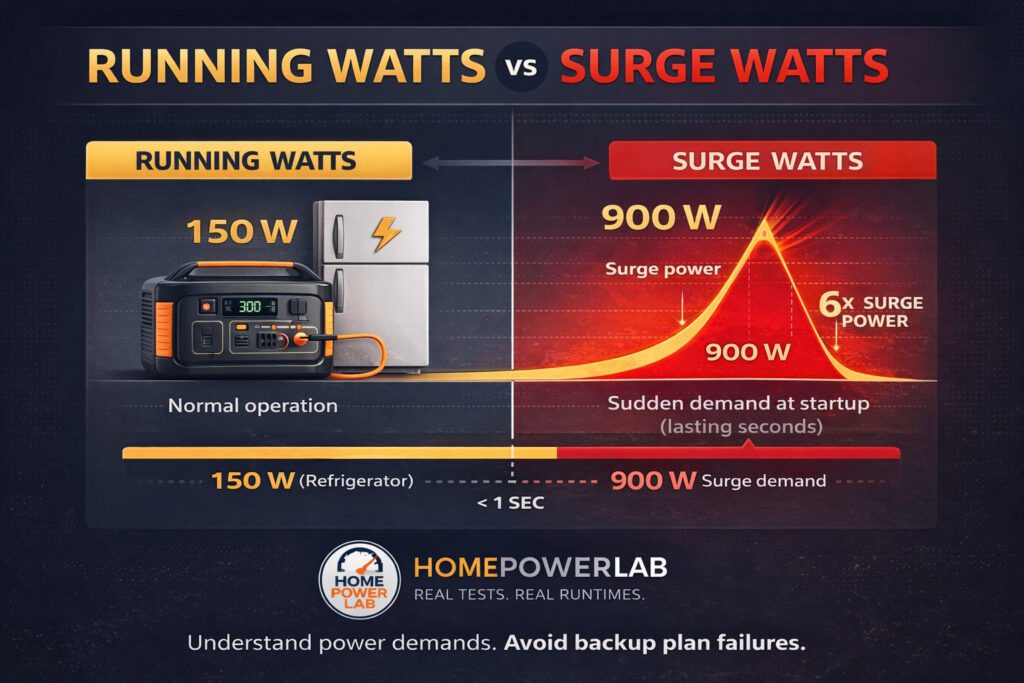
A winter storm takes down the grid overnight. The house is dark and quiet, but the refrigerator is still cold. Sitting on the kitchen floor is a fully charged portable power station, purchased specifically for moments like this. The box said it could handle 2,000 watts—more than enough for a refrigerator that only draws about 150 watts while running.
- Most appliance failures happen at startup, not during normal operation
- Surge power is often 3–5× higher than running load
- Cold temperatures and low battery states reduce surge tolerance
- A successful test once does not guarantee outage reliability
You plug it in. The fridge hums back to life. The plan appears to be working.
An hour later, the refrigerator’s compressor shuts off, as it normally does. A few minutes pass. Then it tries to start again.
The power station shuts down instantly.
There is no warning message. No obvious fault. The battery still shows plenty of charge, and the unit works fine when you plug in a lamp or charge a phone. When grid power returns days later, the refrigerator works perfectly. Nothing is broken.
Yet the backup plan failed precisely when it was needed most.
This kind of failure is common, predictable, and rarely explained clearly. It is not about battery capacity. It is not about advertised watt-hours. It is about surge power and quietly undermines backup power setups more than almost any other factor.
Why Surge Power Is the Silent Killer of Portable Power Stations – Start Here
Why This Is Commonly Misunderstood
Surge power problems persist because the way portable power stations are marketed does not match how electrical systems behave in real life.
Most buyers are presented with a few simplified numbers: continuous wattage, battery capacity, and perhaps a short list of “supported appliances.” These numbers feel concrete and comparable. Unfortunately, they leave out the most stressful moment an electrical system ever experiences: startup.
Several systemic issues contribute to the confusion:
- Single-number specifications. Continuous output ratings are easy to advertise. Surge behavior is harder to summarize and often buried in footnotes or omitted entirely.
- Clean testing environments. Many demonstrations are conducted indoors at room temperature, using warm appliances and carefully sequenced loads.
- Appliance labels that hide the real demand. Nameplates and EnergyGuide labels show average or running consumption, not startup behavior.
- Influencer incentives. Reviews tend to show what works smoothly. Failed starts and shutdowns are often edited out or avoided altogether.
The result is not consumer ignorance. It is a mismatch between how systems are described and how they actually behave under stress.
Most portable power stations advertise a surge rating—but almost never explain how long that surge can be sustained.
In many cases, surge power is measured in milliseconds (ms), while real appliances—especially compressors—may demand elevated power for one to several seconds.
A unit labeled “3,000W surge” may only tolerate that load for 10–20 ms before protection logic intervenes. That’s enough for a lab test—but often not enough for a refrigerator restart.
This gap between how surge is measured and how appliances actually behave is one of the biggest reasons backup plans fail quietly during outages.
Key Definitions
- Surge power: A short-duration burst of power required when certain devices start, often several times higher than their normal running load.
- Continuous power: The amount of power a system can supply steadily without overheating or shutting down.
- Inverter: The electronics that convert stored DC battery power into household AC power.
- Inrush current: The brief spike of current drawn when a motor or transformer is first energized.
- Compressor load: A motor-driven load, such as a refrigerator or freezer, that has especially high startup demand.
These concepts matter because most portable power station failures occur at startup, not during steady operation.
How the System Actually Works
A portable power station is not simply a large battery with outlets. It is a tightly controlled electrical system with multiple layers of protection. Understanding surge failures requires understanding how power flows through that system.
Power Flow During Startup (Simplified)
- Appliance demands a sudden burst of current
- Inverter attempts to supply surge while holding voltage
- Battery delivers high instantaneous current
- Protection logic evaluates current, voltage, and temperature
- If limits are exceeded, output shuts down
Failure at any step triggers a shutdown—even if it lasts only milliseconds.
The chain of events looks like this:
- The appliance starts. A refrigerator compressor, microwave transformer, or power tool motor suddenly demands a large amount of current.
- The inverter responds. The inverter must instantly supply that power while maintaining stable voltage and frequency.
- The battery supplies current. The battery must deliver a high burst of current to support the inverter.
- Protection logic intervenes. If current, voltage, or temperature limits are exceeded, the system shuts down to protect itself.
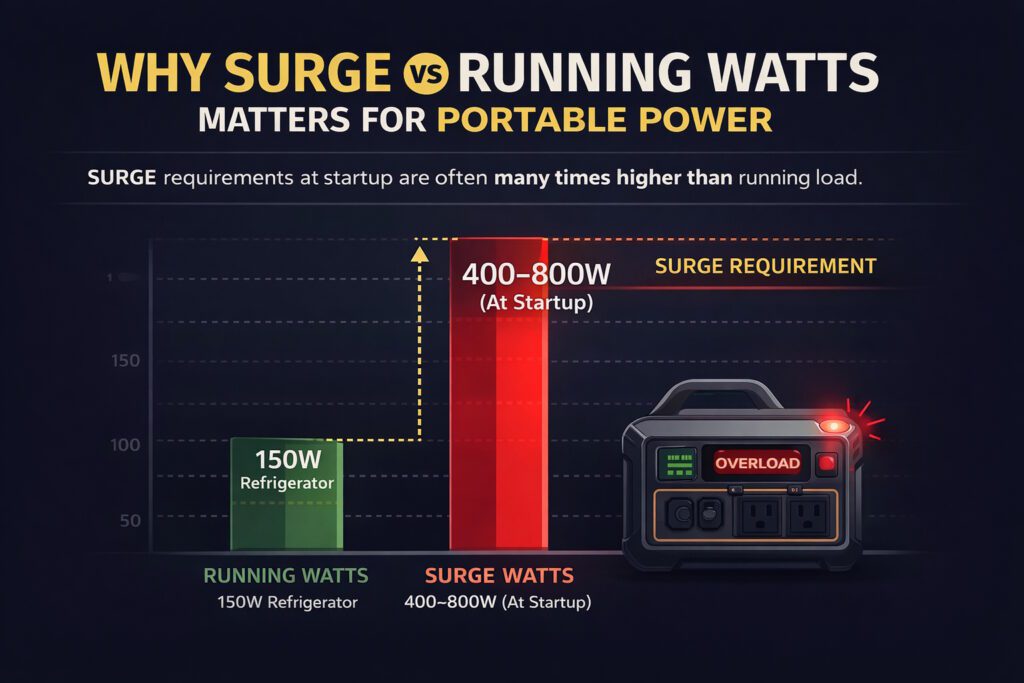
If any link in this chain cannot handle the surge—even for a fraction of a second—the output shuts off.
This is why shutdowns feel abrupt and confusing. The protection system is doing exactly what it was designed to do. From an engineering standpoint, this is a design boundary, not a malfunction.
Typical Running vs. Surge Power (Real-World Ranges)
| Appliance / Load | Typical Running Watts | Typical Surge Watts | Why It Spikes |
|---|---|---|---|
| Refrigerator | 120–200 W | 600–1,200 W | Compressor motor overcoming internal pressure |
| Chest Freezer | 100–180 W | 800–1,500 W | Larger compressor, longer cold start |
| Sump Pump (1/3 HP) | 700–900 W | 2,000–3,000 W | Induction motor + water head pressure |
| Microwave | 1,000–1,200 W | 1,500–2,000 W | Transformer and magnetron startup |
| Coffee Maker | 800–1,200 W | 1,200–1,800 W | Heating element and control electronics |
| Circular Saw | 1,200–1,800 W | 2,500–3,500 W | Motor inertia and blade load |
These surges may last only milliseconds, but they define whether the system succeeds or fails.
Real-World Conditions That Change Outcomes
Surge behavior is not fixed. It changes based on conditions that are common during outages.
Cold temperatures reduce the amount of instantaneous current a battery can deliver. A power station that works fine in a garage during summer testing may struggle in a cold kitchen during a winter blackout.
Cold starts increase surge demand. Appliances that have been off for hours—especially compressors—often draw more current than units that have been cycling regularly.
Stacked surges are a frequent problem. A refrigerator restarting while a microwave is running or a power tool is plugged in can exceed limits even if each device works fine on its own.
Battery state of charge matters. As the voltage drops, the inverter has less headroom to handle sudden spikes.
Human behavior during outages compounds the issue. People repeatedly plug and unplug devices and test equipment, unintentionally creating worst-case startup scenarios.
None of these conditions are unusual. They are normal during real outages.
Failure Modes & Edge Cases
Surge-related failures rarely look dramatic. They are subtle and easy to misinterpret.
- Instant shutdowns happen faster than displays can update, leaving no clear explanation.
- Intermittent success leads users to believe a device is compatible when it only works under favorable conditions.
- “It worked yesterday” scenarios occur when the temperature, battery level, or startup timing changes.
- Silent derating may reduce available surge capacity without obvious indicators as the battery drains.
These failures often feel random. In reality, they are predictable interactions between load behavior and protection limits.
What Consistently Works (and Why)
Across real-world testing, certain principles hold up reliably.
Headroom beats optimization. Systems that operate well below their rated limits tolerate surges far better than systems pushed close to maximum output.
Fewer critical loads reduce risk. Running one high-surge appliance reliably is easier than juggling several smaller ones.
Soft-start technology helps. Appliances or add-on devices that reduce inrush current dramatically improve compatibility with portable systems.
DC loads are inherently safer. When devices can run directly from DC outputs, the inverter—and its surge limits—are removed from the equation entirely.
These are design realities, not brand-specific tricks.
Practical, Risk-Aware Guidance
Plan for startup, not averages. Running wattage is only half the story.
Assume cold, worst-case conditions. Especially for outage planning, optimism leads to failure.
Avoid relying on one-time tests. A single successful startup does not establish reliability.
When estimating total load, do not add all surge values together. A conservative planning model assumes:
Total Load ≈ Sum of Running Loads + Largest Single Surge
This reflects real behavior: one major motor starting while other devices are already running.
Test safely at home:
- Start high-surge devices first, with nothing else connected.
- Repeat tests at lower battery states.
- Let appliances cool fully between tests to simulate real outages.
If you want real answers instead of estimates, a simple plug-in power meter can reveal how your own appliances behave.
Devices like a Kill-A-Watt meter (typically ~$20) allow you to observe startup spikes, running load, and variability across restarts.
While not perfect, this kind of measurement often explains why an appliance that “should work” on paper fails in practice.
The goal isn’t precision—it’s understanding your system’s real margins before an outage forces the lesson.
Where available, calculators and simulators that model surge behavior, inverter limits, and battery state can prevent costly mistakes—especially when they force conservative assumptions.
HomePowerLab Perspective
HomePowerLab evaluates portable power systems under conditions that mirror actual outages: cold starts, partial battery states, mixed loads, and repeated cycling.
One consistent finding stands out: systems rarely fail during steady operation. They fail at transition points—when something starts, restarts, or stacks unexpectedly.
In repeated testing, portable power stations rarely fail during steady loads. Nearly all shutdowns occur during transition events—cold starts, compressor restarts, or stacked surges at partial battery states.
Systems that survive three consecutive cold starts at ~50% battery show significantly higher real-world reliability than systems tested once at full charge.
Lab insight: A setup that survives three consecutive cold starts at 50% battery is usually more reliable than one that succeeds once at 100%.
This is why surge behavior is treated as a primary constraint rather than a secondary detail.
Explicit Takeaways
- Motor-driven appliances often require several times their running power at startup.
- Surge tolerance is limited by inverter design and protection logic, not battery capacity alone.
- Cold temperatures and low battery states reduce surge handling capability.
- A single successful test does not guarantee outage reliability.
- Planning with margin improves reliability more than maximizing advertised wattage.
Surge Power FAQ
What is surge power on a portable power station?
Surge power is the short burst of output a power station can provide during startup events. It matters most for motors and transformers—like refrigerator compressors, sump pumps, microwaves, and many power tools.
Why does a refrigerator trip a power station if it only runs at ~150 watts?
The 150W number describes steady operation. The compressor can briefly draw several times that amount when starting or restarting, and that startup spike can exceed the inverter’s surge tolerance and trigger overload protection.
Is “surge watts” the same thing as battery capacity (watt-hours)?
No. Watt-hours describe how long you can run loads. Surge capability is about how much instantaneous power the inverter and battery can deliver without tripping protections. A large battery can still fail surges if inverter limits are conservative.
Why does it work once and fail later?
Startup demand changes with temperature, compressor restart pressure, and battery state-of-charge. A warm start at 100% battery can succeed, while a cold restart at 45% battery can fail—even with the same appliance.
How should I model total load when multiple devices are running?
A conservative planning model is: total load ≈ sum of running loads + the largest single surge. This matches a common real scenario where one major motor starts while other devices are already running.
What’s the safest way to test surge compatibility at home?
Test one device at a time. Start the high-surge device first with nothing else connected, then repeat at lower battery levels. Avoid makeshift wiring or any method that bypasses protection features.
Do cold temperatures really reduce surge performance?
Often, yes. Cold can reduce battery current delivery and can increase motor startup demand. Outage planning should assume less favorable conditions than an indoor demo test.
Conclusion: Preparedness as Understanding
Preparedness is often framed as buying more equipment or chasing bigger numbers. In practice, preparedness is about understanding constraints.
Surge power explains why portable power stations fail quietly, why ratings feel misleading, and why confidence built on averages collapses under stress. When these dynamics are understood, backup power stops being a gamble and becomes a managed system.
Portable power stations are neither fragile nor deceptive. They are electrical systems operating within strict boundaries. Learning where those boundaries are—and planning accordingly—is what turns backup power from a hope into a dependable tool.

Leave a Reply
You must be logged in to post a comment.