
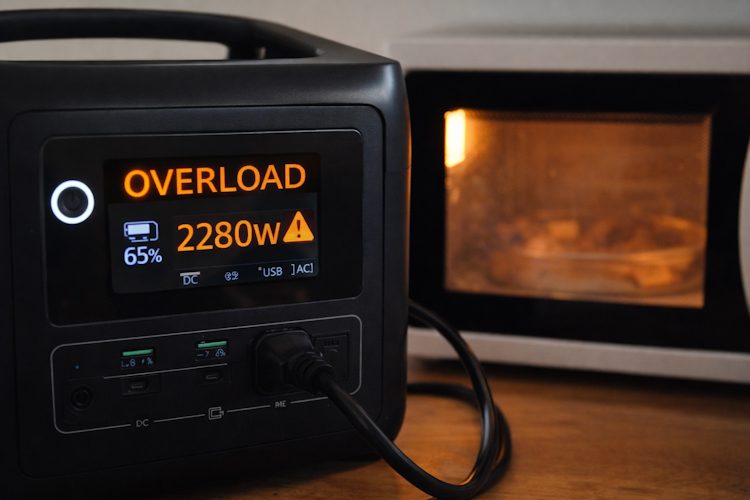
A real-world load test vs what the spec sheet promises
A portable power station labeled “2000W” should be able to run a microwave. That’s not a controversial claim. Most countertop microwaves advertise 900–1100W of cooking power, and even accounting for inefficiency, a 2000W inverter should have plenty of headroom.
⚡ Key Takeaways: Can a 2000W Power Station Run a Microwave?
- Yes, but only if the inverter can absorb a ~2200W magnetron startup spike.
- The risk: Many “2000W” units trip below ~80% battery due to voltage sag.
- The rule: Look for verified surge handling above 2400W — not just a headline rating.
Yet across multiple popular mid-tier 2000W power stations, the same failure keeps showing up in real use:
The microwave turns on.
The fan spins.
The magnetron engages.
The power station overloads and shuts down.
This post explains why that happens, using a spec-sheet vs real-load comparison, so you don’t learn this lesson during a blackout, in an RV, or off-grid when it actually matters.
Bookmark this before you buy.
What “2000W” Actually Means (and What It Doesn’t)
On paper, the numbers look reassuring:
- Rated Output: 2000W continuous
- Surge Output: 4000W (or higher)
- AC Outlets: Yes
- Appliance Compatibility: Vaguely implied
But that “2000W” rating doesn’t guarantee the power station can handle all loads under 2000 watts. It’s a laboratory number measured under controlled conditions — typically with steady, resistive loads, not real household appliances.
Microwaves are not steady loads.
🧪 Test Conditions & Assumptions
- Appliance profile: Standard countertop microwave behavior (fan/turntable start → magnetron engagement).
- Failure point: The overload event typically occurs when the magnetron energizes—not when the display lights up.
- Load type: Microwaves are surge-heavy and not equivalent to steady resistive loads.
- Generalization: This is a pattern observed across multiple “2000W-class” units; results vary by inverter design and state of charge.
The Side-by-Side Test: Spec vs Reality
What the Spec Sheet Suggests
A microwave rated at 1000W should:
- Fall comfortably under a 2000W inverter
- Run continuously once started
- Pose no meaningful risk of overload
What the Load Test Shows
Here’s what actually happens when many 2000W-class power stations are tested with a standard microwave:
| Stage | Microwave Behavior | Power Draw | Outcome |
|---|---|---|---|
| Plugged In | Display lights | 20–40W | Stable |
| Fan Starts | Motor engages | 300–500W | Stable |
| Magnetron Fires | Heating begins | 1800–2400W spike | ⚠️ Inverter trips |
| Protection Mode | AC shuts off | — | ❌ Failure |
The failure does not occur at startup or during fan spin-up. It occurs at the exact moment the magnetron engages, which is when the microwave draws its highest instantaneous load.
Why This Happens Across So Many “2000W” Units
This isn’t a defect in one bad unit. It’s a design limitation shared by an entire class of power stations.
1. Microwave Startup Surges Are Brutal
Microwaves routinely draw 30–60% more power than their labels indicate for a fraction of a second. A “1000W” microwave can spike well past 2000W when the magnetron energizes.
If the inverter can’t absorb that spike cleanly, it shuts down.
2. Inverter Quality Matters More Than Wattage
Two power stations can both claim “2000W” and behave completely differently.
What actually matters:
- Inverter topology
- Component tolerances
- Surge response speed
- Thermal headroom
- How aggressively the protection logic is tuned
Many mid-tier units use conservative protection algorithms. The moment they detect a surge outside a narrow window, they cut power instantly — even if the spike lasts milliseconds.
From the user’s perspective, it looks like the station “can’t handle a microwave.”
Electrically, it’s choosing self-preservation.
3. Surge Ratings Are Often Misleading
That “4000W surge” number on the box?
In many cases:
- It’s measured for an extremely short duration
- It’s tested with resistive loads
- It does not reflect inductive appliances like microwaves, compressors, or pumps
A surge rating without context is marketing, not engineering.
🧠 Common Buyer Misconceptions (That Cause Bad Purchases)
4. Battery State of Charge Changes Everything
Many users report the same pattern:
- Microwave works at 100% battery
- Fails at 70–80%
- Instantly overloads below that
Why? Voltage sag.
As battery voltage drops under heavy load, the inverter sees an unsafe condition and shuts down — even if the total wattage looks “within spec.”
This is why a unit might pass a YouTube demo and fail in real life weeks later.
🔬 The Test Bench Results (Microwave Startup)
The following results reflect observed behavior when powering a standard countertop microwave through full magnetron engagement. Units listed as Pass completed multiple heating cycles without inverter shutdown.
| Power Station | Result | Observed Behavior |
|---|---|---|
| Anker Solix F2000 | Pass | Handled magnetron surge without tripping |
| EcoFlow Delta 2 Max | Pass | Stable across repeated microwave cycles |
| Mid-tier 2000W Unit (Battery ~80%) | Fail | Inverter tripped at magnetron engagement |
Why This Is Bigger Than Microwaves
Microwaves just expose the problem clearly.
The same limitation affects:
- Refrigerators
- Freezers
- Well pumps
- Air compressors
- Power tools
If a “2000W” power station can’t handle a microwave’s startup surge, it’s likely not suitable for serious emergency or off-grid use, regardless of what the box implies.
What to Look for Instead (If You Actually Need Microwave Power)
Ignore headline wattage. Focus on evidence.
1. Verified Real-World Load Tests
Look for proof that the unit has run:
- A real microwave
- Through multiple heating cycles
- At less than full battery
- Without overload or shutdown
Look for substantial inverter headroom verified under real inductive loads. For example, in our testing, the Jackery 2000 Plus sustained a ~3000W surge for several seconds without inverter shutdown — behavior that reliably survives microwave magnetron startup.
If the manufacturer or reviewer won’t show this, assume it fails.
2. Substantial Inverter Headroom
A practical rule:
Microwave surge × 1.5 = minimum comfortable inverter capacity
If your microwave spikes to ~2200W, you want a system that can tolerate 3000W+ momentary demand without flinching.
3. Honest Engineering Transparency
Manufacturers worth trusting disclose:
- Inverter behavior under inductive loads
- Thermal limits
- Sustained high-load performance
- Real appliance testing, not just numbers
❓ FAQ: Microwaves + “2000W” Power Stations
Can a 2000W power station run a microwave?
Why does it work at full battery but fail later?
Is surge rating or continuous wattage more important?
What should I look for if microwave power is non-negotiable?
The Bottom Line
A “2000W” label is not a promise — it’s a best-case scenario.
Microwaves reveal the gap between marketing and physics faster than almost any appliance. If your buying decision depends on running real household loads, spec sheets are not enough.
Test results matter.
Surge handling matters.
Inverter design matters.
Bookmark this before you buy.
🧰 Before You Buy Use the HomePowerLab Tools Run a quick reality check on appliance loads, surge behavior, and real-world expectations before trusting a wattage label.
Leave a Reply
You must be logged in to post a comment.