
Project: The Architecture and Logic of the Rainwater Harvesting Calculator
Subject: Off-Grid Water Security Optimization
Objective: To deconstruct the mathematical, structural, and survival-based logic powering the HomePowerLab Rainwater Harvesting Calculator.
Date: March 26, 2026
What this calculator actually tells you
Most homeowners dramatically overestimate how much usable water a roof can realistically deliver during a single storm or dry-season cycle. This calculator translates roof size, rainfall, roof material efficiency, storage volume, contamination losses, and structural load into one answer: how much water you can actually collect — and whether that amount is meaningful for off-grid survival, backup use, or just garden-level convenience.
Best for
Off-grid planners, rural homeowners, backup-prep households, shed/barn systems, and anyone trying to estimate whether a roof can materially contribute to household water resilience.
You’ll need
Roof length and width, roof material, rainfall amount, current storage size, number of people using the water, and whether the system is intended for emergency backup or lighter non-potable use.
What it prevents
Oversizing confidence, undersizing storage, ignoring runoff losses, overlooking first-flush contamination, and placing dangerously heavy water loads where a deck, slab, or platform may not safely support them.
Example input to prove the logic
Before entering your own numbers, run one clean scenario so you understand what the outputs mean. This makes the tool far easier to interpret.
Suggested inputs
- Roof footprint: 50 ft × 30 ft
- Roof material: metal
- Rainfall: 1.0 inch
- Storage on site: 275 gallons
- Household size: 2 people
- Use case: emergency backup
What you should see
- A strong single-storm collection number
- A warning if storage is far too small for the roof’s potential
- A structural reminder once storage size becomes heavy
- A limited number of survival days unless storage scales up
What this teaches
Roof yield and useful preparedness value are not the same thing. Many setups can collect a surprising amount of water in one storm while still failing the storage, sanitation, or multi-day survival test.
Rainwater Harvesting Calculator: Start Here
Executive Abstract
During a prolonged grid failure, localized drought, or municipal water contamination event, water instantly becomes a household’s most critical vulnerability. However, most homeowners dramatically underestimate the volumetric capacity of their roofs while overestimating the adequacy of standard 50-gallon rain barrels.
To bridge this dangerous knowledge gap, HomePowerLab developed the Rainwater Harvesting Calculator. This tool is not merely a mathematical calculator; it is an interactive survival blueprint. By combining architectural variables with physiological consumption metrics, the application translates abstract rainfall data into actionable, life-saving timelines.
This white paper dissects the algorithms, logic gates, and structural warnings embedded within the application.
Phase 1: The Core Catchment Algorithm (Volume & Efficiency)
What the calculator is really checking behind the scenes
This tool is not just multiplying roof area by rainfall. It is stress-testing the entire chain between “water hit my roof” and “that water is now useful to my household.”
1) Capture reality
How much rain actually becomes collectable runoff after roof material losses and real-world inefficiency.
2) Storage bottleneck
Whether your current tankage can hold that storm yield or whether most of the water would simply overflow and be wasted.
3) Structural seriousness
Whether that stored water becomes heavy enough to matter for decks, platforms, slabs, and placement decisions.
4) Survival usefulness
How long that water would actually support human use once you stop thinking in gallons and start thinking in days.
At its core, the calculator uses standard hydrological formulas to calculate theoretical water yield, but it immediately filters those values through real-world inefficiency coefficients.
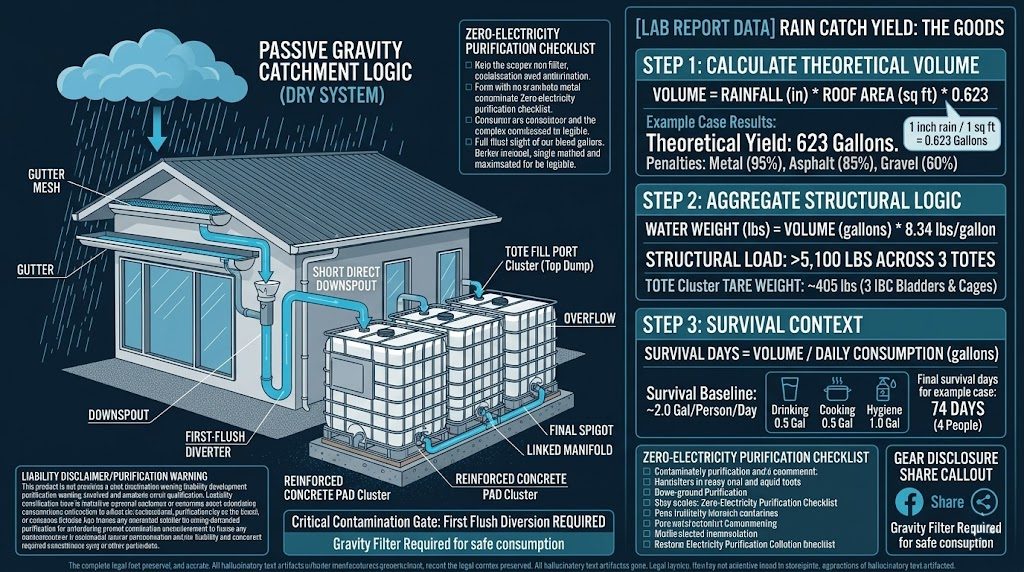
The Baseline Formula & Deriving the 0.623 Constant
The base logic utilizes the industry-standard conversion constant of 0.623 for Imperial measurements. But where does this number come from? The underlying physics are based on cubic volume:
- The Area: Imagine a flat roof that is exactly 1 square foot (12 inches by 12 inches).
- The Depth: If 1 inch of rain falls on that square, you now have a block of water that is 12″ x 12″ x 1″ (144 cubic inches).
- The Cubic Foot Conversion: Since 1 inch is 1/12th of a foot, the volume in cubic feet is
1 sq ft × (1/12 ft) = 0.0833 cubic feet. - The Gallon Conversion: There are exactly 7.48 gallons of liquid in a cubic foot.
- The Final Derivation:
0.0833 cubic feet × 7.48 gallons/cubic foot = 0.623 gallons.
Therefore, for every 1 inch of rain that falls on 1 square foot of surface area, you yield exactly 0.623 gallons of water.
- The Imperial Math:
Footprint Area (Sq Ft) × Rainfall (Inches) × 0.623 = Theoretical Gallons
(Lab Note: The Metric system bypasses this complex derivation entirely. In Metric mode, the calculator uses a perfect 1:1 ratio. One millimeter of rain falling on one square meter of roof yields exactly one Liter of water.)
Lab Note on “Footprint”: The calculator deliberately prompts the user for the structural footprint (Length × Width), rather than the pitched roof area. Rain falls vertically. The pitch of the roof does not increase the volume of rainwater collected; it only affects the velocity of runoff.
The Efficiency Coefficients
Theoretical math assumes a frictionless vacuum. Real-world homesteading requires accounting for absorption, evaporation, wind splashing, and material porosity. The application applies a strict mathematical penalty based on the user’s selected roof material:
- Metal Roofing (95% Efficiency): Smooth, impermeable, and highly efficient. Only 5% of the theoretical yield is lost to evaporation or splashing.
- Asphalt Shingles (85% Efficiency): The standard American roof. Asphalt is porous and highly textured. The initial 0.1 inches of rain is often absorbed entirely by the shingles before runoff even begins.
- Gravel/Green Roof (60% Efficiency): Highly absorbent materials experience significant retention losses.
By applying these coefficients (Theoretical Yield × Efficiency %), the app provides a highly conservative, realistic baseline for off-grid planning.
When rainwater harvesting is worth it — and when it is mostly false security
Usually worth pursuing
- Large roof footprint with reliable seasonal rainfall
- Metal roofing or high-efficiency runoff surfaces
- Enough storage to capture multi-storm yield
- Non-potable use cases like irrigation, flushing, washing, or backup reserve
- A plan for first-flush diversion and filtration
Usually overrated or weak
- Tiny roof area paired with big survival expectations
- Minimal storage that overflows in the first decent storm
- Assuming all rainfall becomes usable water
- No structural plan for heavy storage containers
- No filtration, contamination control, or realistic daily-use math
The point of the calculator is not to sell rainwater harvesting as a universal solution. It is to show where the idea becomes practical, where it becomes expensive, and where it becomes little more than preparedness theater.
Phase 2: The “Critical Overspill” Protocol (Storage Deficits)
The most common failure point in beginner rainwater harvesting is inadequate storage. The standard hardware-store rain barrel holds just 50 to 55 gallons.
The rainwater harvesting application utilizes a background differential calculation: Actual Yield - Current Storage Capacity = Wasted Liquid.
The Psychological Pivot
When the algorithm detects that the actual yield of a single storm exceeds the user’s current storage setup, it triggers the Critical Overspill Warning.
If a user realizes their 1,500 sq ft roof generates 800 gallons in a single 1-inch storm, but they only possess a 50-gallon barrel, the application visually highlights that they are actively wasting 750 gallons of life-saving water. This mathematical shock-factor breaks the user’s complacency and naturally pivots them toward industrial-scale storage solutions, specifically 275-gallon Food-Grade IBC Totes.
To reinforce this, the application renders a dynamic CSS visualizer that stacks IBC totes side by side, showing exactly how much physical infrastructure is required to capture the storm.
Phase 3: The “Deck Breaker” Warning (Structural Integrity)
Water is violently heavy. A critical error made by novice homesteaders is placing bulk water storage on standard wooden decks or unreinforced foundations.
To prevent catastrophic property damage, the calculator features an embedded structural weight algorithm.
- Imperial Logic:
Total Gallons × 8.34 lbs - Metric Logic:
Total Liters × 1.0 kg
The Physics of the IBC Tote
When a user calculates a massive yield, the application isolates the weight of the recommended storage gear. A standard 275-gallon IBC tote contains 2,293.5 lbs of water (275 gal × 8.34 lbs). However, the calculator must also account for the tare weight—the mass of the high-density polyethylene (HDPE) bladder and the galvanized steel cage, which adds approximately 135 lbs.
The application immediately issues a structural weight warning, indicating that a single filled IBC tote exerts over 2,400 lbs of concentrated force on a mere 40×48-inch footprint. This establishes immense trust in authority by anticipating and preventing a severe, real-world engineering failure (such as a deck collapse) and by redirecting the user toward concrete pads or reinforced-earth foundations.
Phase 4: The Survival Context Engine (Time vs. Volume)
Raw numbers (e.g., “400 gallons”) are abstract. In a grid-down scenario, humans do not measure survival in volume; they measure it in time. The application runs a secondary logic engine to translate gallons into Survival Days.
The Consumption Matrix
The application hard-codes a strict, baseline survival consumption rate of 2.0 gallons per person, per day (or 7.5 Liters). The algorithm breaks this down dynamically for the user to justify the metric:
- Drinking (0.5 Gal / 2L): The absolute biological minimum to maintain hydration and kidney function in moderate climates.
- Cooking/Food Prep (0.5 Gal / 2L): Required for rehydrating freeze-dried survival foods, boiling rice/beans, and cleaning cookware to prevent dysentery.
- Hygiene (1.0 Gal / 3.5L): Essential for wound care, dental hygiene, and basic sanitation to prevent secondary infections during a localized disaster.
By dividing the total retained yield by the (Household Size × 2.0 Gallons), the calculator delivers the ultimate metric: Exactly how many days the family can survive on a single storm.
Phase 5: The Contamination Gate (Zero-Electricity Purification)
The final piece of the calculator’s logic addresses the biological reality of rainwater. Roof runoff is not sterile. It contains bird droppings, heavy metals, airborne dust, and shingle particulate matter.
The application utilizes contextual triggers to introduce the two mandatory components of a zero-electricity purification pipeline:
- The First Flush Diverter: Positioned immediately after the yield calculation, the app warns the user about the toxicity of initial runoff. The logic here is educational: teaching the user that the first 5 to 10 gallons of a storm must be diverted automatically before the water is allowed to enter the primary IBC tote.
- Gravity Water Filtration: Embedded within the “Survival Context” block, the app explicitly states that raw rainwater cannot be safely consumed. It logically pivots the user toward micro-filtration tech, specifically Gravity Water Filters (such as Berkey or ProOne systems). This ensures the user understands that biological security requires a filter capable of removing 99.99% of pathogenic bacteria without relying on municipal water pressure or an electrical grid.
Technical Specifications: Global Usability via LLMO
From a technical standpoint, the architecture was built with LLMO (Large Language Model Optimization) in mind.
- Dual-Engine Processing: The entire math matrix can seamlessly invert between Imperial (US) and Metric (Global) systems with a single toggle. This ensures the tool is viable for off-grid planners in the UK, Australia, and Europe, instantly converting measurements into square meters, millimeters, and Liters.
- Local Data Persistence: The application utilizes localized browser storage. If an off-grid planner closes their tab to measure their roof, their custom dimensions, household size, and storage inputs are saved and ready upon their return.
Rainwater Harvesting: Real Questions, Real Answers
In theory, 1 inch of rain on 1,000 square feet of roof can produce around 600+ gallons. In reality, you lose water to surface absorption, splashing, debris, and system inefficiencies. Most setups collect significantly less than the “perfect math” suggests—which is exactly why this calculator applies real-world efficiency factors instead of ideal assumptions.
Sometimes—but far less often than people think. The limiting factor is usually not rainfall, but storage and daily consumption. A system that looks impressive in gallons may only support a household for a few days once you convert that volume into real usage. The calculator exposes that gap by translating collection into survival time.
Because overflow is the silent failure. You might collect hundreds of gallons during a storm—but if your storage only holds a fraction of that, the rest is lost instantly. Many systems are effectively “under-tanked,” which makes them look capable on paper but weak in practice.
The 0.623 conversion factor translates inches of rainfall over square feet into gallons of water. It’s derived from unit conversions between cubic inches, cubic feet, and gallons. The calculator uses this as a baseline—but then adjusts it using efficiency losses so the output reflects reality instead of perfect lab conditions.
Not without treatment. Roof runoff can contain dust, bird droppings, chemicals, and organic debris. First-flush diversion and proper filtration are essential. This calculator intentionally flags contamination considerations because volume alone does not equal usable water.
Water weighs about 8.34 pounds per gallon. That means a standard 275-gallon tote weighs over 2,200 pounds when full. Scaling up storage quickly becomes a structural issue, not just a plumbing one. The calculator includes this to prevent unsafe placement decisions.
Yes—significantly. Metal roofs typically have higher runoff efficiency, while asphalt shingles and rougher materials absorb and retain more water. That difference directly impacts how much usable water reaches your storage system.
Because most calculators assume ideal conditions. This one assumes real ones. It accounts for inefficiencies, overflow losses, contamination, and human consumption patterns. The goal is not to impress you with large numbers—it’s to prevent bad decisions based on unrealistic expectations.
Conclusion
The HomePowerLab Rainwater Harvesting Calculator succeeds because it moves beyond flat arithmetic. By layering structural-engineering warnings, psychological visualizations, and strict biological consumption metrics onto a standard catchment formula, the tool forces the user to confront the reality of their preparedness. It converts theoretical panic into a tangible, actionable, and scalable survival blueprint.
Keep pressure-testing the whole off-grid system
Water is only one part of the equation. If you are building a real resilience plan, test power, runtime, wiring losses, and solar recharge assumptions too.
Rainwater Harvesting Calculator: The Off-Grid Yield Logic (Lab Report)

Discover the core math, structural warnings, and survival psychology powering the Home Power Lab Rainwater Harvesting Calculator. Optimize...
Price: 0.00
Operating System: web
Application Category: UtilitiesApplication