
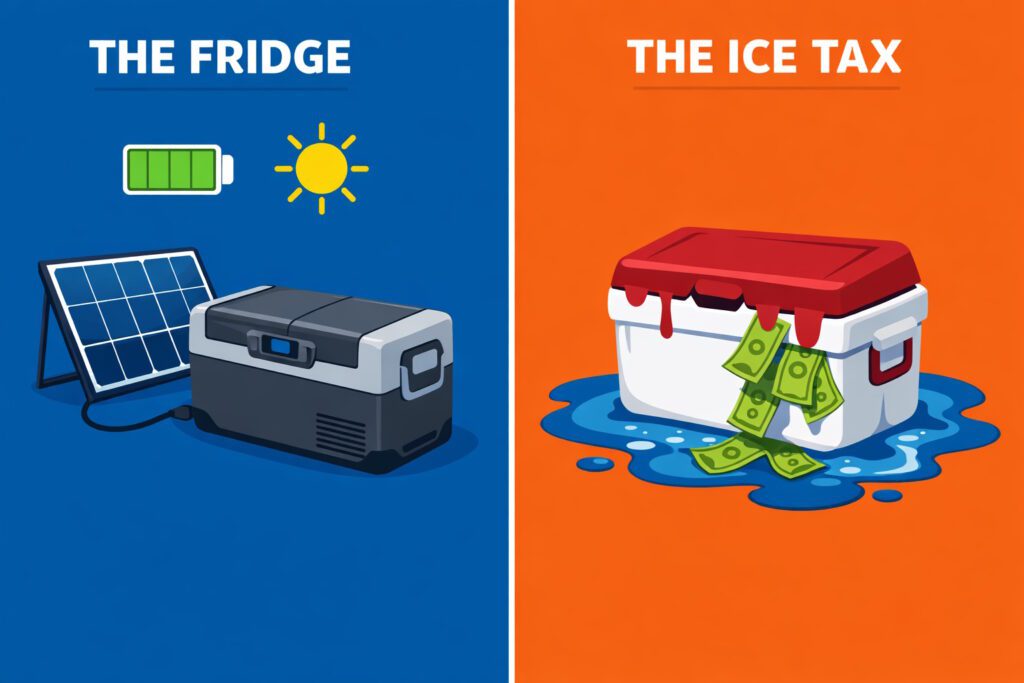
Project: The Ice Chest vs. 12V Fridge Auditor
Subject: Nomad Energy Economics, Thermodynamics, ROI Analysis
Date: February 22, 2026
Lab Snapshot
Use this header like a “control panel.” It gives readers the verdict context, then lets them jump directly to the simulator, methodology, and the cost logic without scrolling through the full report.
Lab Report: Abstract
The single most contentious debate in the mobile living and overlanding community revolves around food preservation: The High-End Cooler vs. The 12V Compressor Fridge.
The conventional wisdom suggests that 12V fridges (costing $300–$1,000+) are a luxury item, while ice chests (costing $50–$300) are the “budget-friendly” option. Our hypothesis at HomePowerLab is that this economic model is flawed because it ignores the First Law of Thermodynamics and the cumulative variable cost of ice (the “Ice Tax”).
To test this, we built a proprietary physics engine—The Fridge Auditor—that simulates heat flux, compressor duty cycles, and material costs over a 10-year timeline. This report details the logic behind that tool and the financial reality it exposes.
Interactive Lab Tool
This simulator turns the “fridge vs. ice” argument into a measurable comparison. Set your conditions, then watch how fast recurring ice spending overtakes upfront hardware.
Assumptions & Controls
- Ambient temperature materially changes both compressor duty cycle and melt rate.
- Ice is treated as a recurring consumable (repeat purchases + resupply friction).
- Electric cooling costs are expressed through realistic daily energy draw, not marketing “best case.”
- Scenario selection (hot/mild/cold)
- Trip duration (how long you’re away from resupply)
- System choice (fridge/power setup vs. ice chest behavior)
In This Lab Report
The Problem: The “Ice Tax” Fallacy
When a nomad purchases a cooler, they are buying a liability, not an asset. A cooler requires a constant input of consumable material (ice) to function. This creates a variable cost curve that scales linearly with time and ambient temperature.
Conversely, a 12V compressor fridge setup (Fridge + Battery + Solar) represents a high Capital Expenditure (CapEx) but near-zero Operating Expenditure (OpEx).
The “Ice Tax” is not just the $5 bag of ice. It is a compound metric consisting of:
- Direct Cost: The cash price of the ice.
- Thermal Loss: The volume of the cooler occupied by ice (often 40-50%) rather than food.
- The Hassle Factor: The fuel and time cost of deviating from a route to find a store.
- The Environmental Toll: The single-use plastic waste generated per bag.
Methodology: Inside the Physics Engine
To accurately audit these two systems, our web application effectively runs a thermodynamic simulation based on user inputs. Here is the logic powering the Auditor:
Heat Ingress Calculation ($Q$)
The core of the simulation calculates the amount of heat energy entering the insulated box from the outside environment. We use a simplified version of Fourier’s Law of Thermal Conduction:$$Q = \frac{A \cdot \Delta T}{R_{value}}$$
Where:
- $Q$: Heat Gain (BTU/hr).
- $A$: Surface Area of the fridge/cooler (derived from the Volume input in Liters).
- $\Delta T$ (Delta T): The temperature difference between the outside air and the internal target ($37^\circ F$).
- $R_{value}$: The thermal resistance of the insulation (Low for cheap coolers, High for rotomolded/insulated covers).
The Day/Night Correction: Early simulations failed because they assumed the “High Temp” persisted for 24 hours. The Auditor now applies a Weighted Temperature Average, calculating heat loss separately for Daytime Highs and Nighttime Lows to generate a realistic 24-hour load profile.
The Energy Conversion (Ice vs. Electrons)
Once we know the total Heat Gain ($Q_{total}$) for a 24-hour period, we convert that thermal load into two different “currencies”:
Currency A: The Latent Heat of Fusion (Ice): To maintain the temperature in a cooler, the ice must absorb the incoming heat by melting.
- Constant: It takes 144 BTUs of energy to melt 1 lb of ice at $32^\circ F$ into water at $32^\circ F$.
- Logic: $Lbs_{Ice} = Q_{total} / 144$.
Currency B: Electrical Power (Compressor): To maintain the fridge’s temperature, the compressor must remove heat.
- Constant: We assume a standard Danfoss/Secop-style compressor with a Coefficient of Performance (COP) of roughly 1.6-1.8.
- Logic: $Watts_{Required} = (Q_{total} \times 0.293) / COP$.
- This determines the Duty Cycle (minutes per hour the fridge runs).
Key Findings & Variables
The Fridge Auditor reveals that three primary variables dictate the “Breakeven Point” (the date when the fridge becomes cheaper than the cooler).
Ambient Temperature is the “Battery Killer”
The relationship between ambient temperature and power draw is not linear; it accelerates.
- At $70^\circ F$: A standard 45L fridge might run 15% of the time (~10Ah/day).
- At $95^\circ F$: That same fridge runs 45-60% of the time (~35-50Ah/day).
Implication: Nomads in Arizona (Quartzsite) need 3x the battery capacity of nomads in the Pacific Northwest for the exact same fridge.
The “Hassle Factor” (Valuing Your Time)
Our algorithm includes a “Hassle” toggle. If a user values their time at $20/hr and spends 30 minutes round-trip driving to a gas station for ice every 3 days, the “Cost of Ice” effectively triples.
- Without Hassle: Ice might cost $150/year.
- With Hassle: The cost jumps to $400+/year.
- Result: Adding the “Hassle Factor” usually shifts the Breakeven Point from 3 years down to 14 months.
The Solar “Infinite Loop”
The Auditor checks if the user’s solar yield exceeds the daily consumption. $$Solar_{Yield} = Watts_{Panel} \times SunHours_{Avg} \times Efficiency_{Derate}$$
If $Solar_{Yield} > Consumption$, the variable cost of the fridge drops to effectively zero. The simulations show that a single 100W panel is sufficient for “Weekender” setups ($<75^\circ F$), but 200W+ is required for “Pro” setups ($90^\circ F+$) to achieve self-sufficiency.
The Environmental Audit: The “Eco-Guilt” Metric
One of the most shocking outputs of our simulation is the Plastic Waste Audit.
Assuming a standard 16lb bag of ice comes in a heavy-duty, non-recyclable Low-Density Polyethylene (LDPE) bag:
- Average Melt Rate ($85^\circ F$): ~12 lbs/day.
- Consumption: ~0.75 bags/day.
- 10-Year Impact: A weekend warrior (camping 20 days/year) will send 150 plastic bags to the landfill. A full-timer will send over 2,700 bags.
For the eco-conscious overlander, this data point often outweighs the financial ROI. The 12V fridge is the only zero-waste solution.
Gear Recommendations (Based on Physics)
The Auditor doesn’t just calculate; it prescribes. Based on the calculated Amp-Hours per day ($Ah/day$), we categorize users into three distinct tiers:
- The Weekender ($<20Ah/day$):
- Scenario: Mild temps ($70^\circ F$), high insulation.
- Gear: A simple Jackery 240 or EcoFlow River provides 1-2 days of autonomy without solar.
- The Nomad Standard ($20-50Ah/day$):
- Scenario: Summer temps ($85^\circ F$), standard fridge.
- Gear: Requires a 100Ah LiFePO4 battery (e.g., LiTime/Battle Born) or a 1000Wh Power Station. This is the “sweet spot” for most users.
- The Desert Pro ($>50Ah/day$):
- Scenario: Extreme heat ($100^\circ F+$), frequent door openings.
- Gear: Requires 200Ah+ of Lithium and 200W+ of Solar. Anything less will result in a Low Voltage Cutoff (LVC) by 4:00 AM.
FAQ
Does ice really “cost” that much if I’m only doing short trips? ›
Why does ambient temperature matter so much? ›
- Compressor duty cycle (more runtime to maintain set temp)
- Melt rate (faster loss of cooling capacity)
- Risk cost (food safety margin shrinks as meltwater rises)
What’s the most common mistake people make comparing these? ›
Why not just buy a “better” ice chest? ›
What conditions make the fridge decision obvious? ›
Conclusion
The data derived from the Ice Chest vs. 12V Fridge Auditor is conclusive: The Ice Chest is a trap.
While the barrier to entry is low ($50), the “Ice Tax” ensures that any user camping more than 14 days a year will inevitably pay more for a cooler than a high-end compressor fridge over the lifespan of the gear.
When you factor in the Hassle Factor (lost vacation time) and the Eco-Guilt (landfill waste), the Return on Investment (ROI) for a 12V system is often less than 2 years.
Recommendation: Stop renting the cold. Buy the fridge.
Key Terms: 12V fridge power consumption, 12V refrigerator duty cycle, portable fridge solar requirements, cost of ice vs fridge, camping fridge battery sizing, LiFePO4 for Dometic fridge, Jackery vs EcoFlow for fridge, overlanding refrigeration economics.
12V Fridge vs. Ice Chest: The Physics & Financial Audit
Is a 12V fridge worth the cost? We ran the thermodynamics. Lab Report 042 exposes the hidden "Ice Tax" and proves exactly when a fridge pays for itself.
Price: 0.00
Operating System: web
Application Category: UtilitiesApplication