
Lab Report: The Short Cycle Simulator
Purpose: To mathematically and visually simulate the destructive effects of short-cycling on compressors and prove the efficacy of hardware-based mitigations like soft starters and time delay relays.
Date: May 10, 2026
HomePowerLab Short Answer
A short power flicker can hurt a compressor because the pressure has not reset yet.
A refrigerator, window AC, chest freezer, or central AC compressor needs time for refrigerant pressure to equalize after it shuts off. If power returns too quickly, the motor may try to restart against high head pressure. That can trigger locked-rotor current, voltage sag, thermal overload, breaker trips, or long-term winding damage.
The danger is not always the outage itself. The danger is the restart window after the outage.
What This Short Cycle Simulator Is Actually Checking
Checks
- Short outage restart risk
- Compressor pressure recovery time
- Locked-rotor current exposure
- Generator or inverter voltage sag risk
- Hard-start and delay-timer mitigation
Does Not Approve
- Bypassing appliance protection
- Modifying HVAC wiring
- Oversizing breakers
- Defeating overload protection
- Running unsafe generator connections
Treat this tool as a risk model, not a repair authorization. If the appliance repeatedly trips, hums, stalls, or struggles to restart, stop testing and have the equipment inspected.
Read Your Result This Way
The simulator is not asking whether the compressor can run. It is asking whether it can safely restart.
Low Risk
The compressor has enough delay time, the voltage source is stable, and restart current is unlikely to exceed the available supply margin.
Caution
The system may restart, but the margin is thin. Heat, extension cords, weak generators, or repeated flickers can push it into failure behavior.
High Risk
The compressor may face locked-rotor current before pressure equalizes. Do not keep forcing restarts. Add delay protection or reduce the load path.
The Short Cycle Compressor Killer: Start Here
Abstract: The “Flicker” Epidemic
The most destructive event for a modern home appliance is not a prolonged blackout; it is a brief, transient power flicker. When the utility grid drops for mere seconds and immediately returns—or when an automatic transfer switch (ATS) violently toggles power from the grid to a standby generator—the mechanical and thermal stress placed on residential compressors is catastrophic.
This phenomenon, known as “short-cycling against head pressure,” is the leading cause of premature compressor death in refrigerators, freezers, and HVAC units. Homeowners frequently search for long-tail queries like “refrigerator clicks and hums but won’t cool after a power outage” or “generator short cycle AC failure.” The Short Cycle Simulator was developed by HomePowerLab to decode this invisible threat. By rendering the thermodynamics and electrodynamics of a locked-rotor event in a highly interactive, multisensory web application, users can witness exactly how and why their appliances melt down and mathematically verify which hardware upgrades will save them.
Visual Lab Model
Why the First Restart After a Flicker Is the Dangerous Moment
The compressor may look idle from the outside, but internally the refrigerant circuit may still be pressurized. If power returns before that pressure equalizes, the motor can draw locked-rotor current instead of starting cleanly.
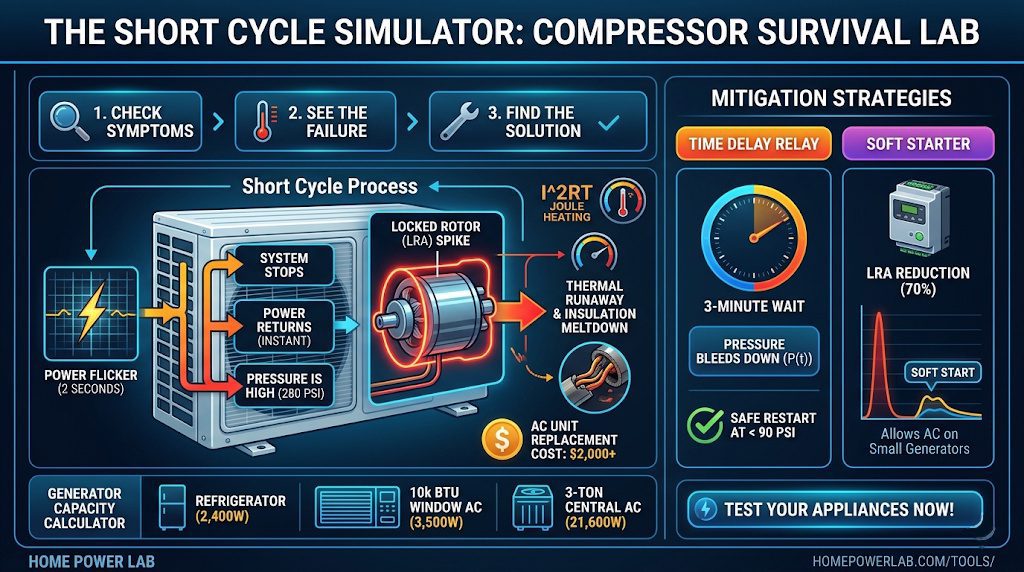
The safest solution is usually not more wattage. It is controlled restart timing, stable voltage, and enough surge margin.
The Thermodynamics of Head Pressure Lockout
The Physics Engine
Head pressure turns a normal restart into a locked-rotor event.
After a compressor shuts off, refrigerant pressure does not instantly equalize. If the compressor is asked to restart too soon, the motor must overcome that pressure before rotation begins. That is when current can spike far above normal running amps.
Restart Risk = Pressure Load + Locked-Rotor Current + Voltage Sag
That is why a compressor may run normally for hours but still fail immediately after a rapid power flicker. Running watts and restart watts are different problems.
To build an accurate simulation, the web app translates the physical laws of vapor-compression refrigeration into a 50-millisecond JavaScript interval loop.
When an air conditioner or refrigerator is actively cooling, the internal compressor acts as a mechanical pump. It compresses low-pressure refrigerant gas into high-pressure, high-temperature gas. In the simulation’s running state, the internal high-side pressure model sits at roughly 280 PSI.
When power is cut, the compressor motor stops instantly. However, the high-pressure gas trapped in the condenser coils slowly bleeds through the expansion valve (TXV) and equalizes with the low-pressure side. The simulator accurately models this decay rate using Newton’s Law of Cooling principles adapted for pressure equalization:$$P(t) = P_{eq} + (P_{run} – P_{eq}) \cdot e^{-t/\tau}$$
Where:
- $P(t)$ = Pressure at time $t$
- $P_{eq}$ = Equalized resting pressure (~70 PSI)
- $P_{run}$ = Active running head pressure (~280 PSI)
- $\tau$ = The system’s time constant (defining the bleed rate)
If power is restored before the pressure equalizes (e.g., within 5 seconds of a power flicker), the compressor attempts to start. Because the high-side pressure $P(t)$ is still exerting a massive backward force on the piston or scroll, the motor’s starting torque ($\tau_{start}$) is insufficient to overcome the mechanical resistance. The motor stalls.
The Electrodynamics of a Locked Rotor (LRA)
Because the physical rotor inside the compressor cannot spin, the back-electromotive force (Back-EMF) that normally limits current draw drops to zero. This state is known as a “Locked Rotor.”
In the simulator’s logic engine, a stalled motor immediately triggers an extreme current draw. Normal Running Load Amps (RLA) for a standard residential compressor might sit at 8.5A. During a locked rotor event, the simulator forces the current to spike to the Locked Rotor Amps (LRA) limit. LRA is typically 5 to 7 times higher than RLA:$$I_{LRA} \approx I_{RLA} \times 6$$
For a 3-ton AC unit, an RLA of 13A results in an LRA spike of nearly 78 Amps.
Thermal Runaway and Joule Heating
This massive influx of electrical current against stationary copper windings generates extreme, localized heat. The simulator calculates the thermal accumulation using Joule’s First Law of Heating:$$Q = I^2 \cdot R \cdot t$$
Where:
- $Q$ = Heat generated (Joules)
- $I$ = Current (Amps)
- $R$ = Resistance of the motor windings (Ohms)
- $t$ = Time (Seconds)
Because the heat generated is proportional to the square of the current, the danger becomes mathematically obvious. Comparing normal operation to a short-cycle stall:
- Normal Heat: $(8.5A)^2 \cdot R \cdot t = 72.25 \cdot R \cdot t$
- Stalled Heat: $(78A)^2 \cdot R \cdot t = 6,084 \cdot R \cdot t$
During a short cycle, the motor generates heat 84 times faster than during normal operation. The simulator’s thermal engine tracks this spike, rapidly pushing the winding temperature from a normal 130°F past the critical 300°F melting point. If the appliance’s internal thermal overload switch fails to trip in milliseconds, the motor insulation melts, permanently destroying the compressor.
The Generator Capacity Matrix Algorithm
One of the most complex features of the Short Cycle Simulator is its ability to cross-reference compressor thermodynamics with portable generator capacity limits. Located at the bottom of the interface, the “Will My Generator Run My AC?” calculator acts as a highly personalized diagnostic tool.
The internal logic engine maps common residential appliances to their known LRA wattage surges using standard power equations ($P = V \times I$):
- Refrigerator: $\approx$ 2,400W Surge
- Window AC (10k BTU): $\approx$ 3,500W Surge
- 3-Ton Central AC: 78A $\times$ 240V $\approx$ 18,720W Surge (Rounded to 21.6kW for safety margins)
The application takes the user’s selected generator’s running wattage ($W_{gen}$) and compares it to the selected appliance’s LRA surge ($W_{surge}$).
Voltage Sag and Generator Stalls
When $W_{surge} > W_{gen}$, the massive inrush current causes a severe voltage drop across the generator’s internal alternator impedance ($Z_{gen}$).$$V_{drop} = I_{LRA} \times Z_{gen}$$
As the voltage sags below 100V (on a 120V leg), the compressor draws even more current to compensate, ultimately tripping the generator’s breaker or stalling the generator’s combustion engine entirely. If the logic detects this imbalance, the simulator flags a critical failure.
Related Lab Checks
Short cycling is only one failure point in the backup power chain.
If a compressor struggles after a flicker, the problem may not be the appliance alone. Restart behavior can be made worse by voltage drop, overloaded generator circuits, or a battery plan that cannot support repeated compressor cycling.
Use these as follow-up checks, not replacements for appliance protection. A stable restart, a safe circuit path, and enough runtime are three different problems.
Hardware Mitigation Modeling
Short Cycle Mitigation: What Each Fix Actually Does
| Mitigation | What It Helps | What It Does Not Fix | Best Use Case |
|---|---|---|---|
| Delay timer | Prevents immediate restart | Does not increase generator capacity | Frequent flickers or utility dropouts |
| Hard-start kit | Improves startup torque | Does not remove pressure imbalance | Compressors with marginal restart behavior |
| Larger generator | Adds surge margin | Does not solve rapid restart timing | Undersized backup systems |
| Dedicated circuit | Reduces competing load sag | Does not change compressor physics | Fridges, freezers, and AC units sharing loads |
The simulation allows users to test two specific preventive measures in real time and mathematically verify their efficacy before purchase.
Mitigation 1: Time Delay Relays (The 3-Minute Rule)
When the user enables “Time Delay Protection,” the simulation alters its restart logic. If a power flicker occurs, the app enters a delay state. Instead of routing power to the compressor immediately, a digital timer intercepts the current.
By forcing a wait period, the relay utilizes the pressure decay formula ($P(t)$) established in Section 1. The user watches the internal PSI gauge bleed down naturally. Only when $t$ is large enough for the pressure to fall below the safe threshold ($P(t) < 90 \text{ PSI}$) does the relay click closed, allowing a safe, low-amp restart.
Mitigation 2: Soft Starters (LRA Reduction)
For users attempting to run heavy HVAC loads on small off-grid generators, the app models the inclusion of a Soft Starter (e.g., Micro-Air EasyStart). When activated, the start logic intercepts the 78A LRA spike.
A soft starter uses an algorithm to ramp up voltage along a multi-stage start curve, rather than delivering 100% voltage instantaneously. The app mathematically applies a 70% reduction to the inrush current:$$I_{soft} = I_{LRA} \times 0.30$$
In our 3-ton AC example, the 78A locked-rotor spike is reduced to a highly manageable 23.4A. By recalculating the Joule heating ($Q$) and the generator surge demand ($W_{surge}$), the app demonstrates how a compressor can safely bypass the head pressure lockout without melting its windings or stalling a portable 5,000-watt generator.
Economic Impact and Solutions
By explicitly linking the physics of a short cycle to the financial reality of appliance replacement, the simulator bridges the gap between mechanical engineering and homeowner economics. The dynamic damage ticker calculates a $2,000 financial loss in real time as the windings melt, creating a stark contrast with the cost of preventive hardware.
Based on the load profile selected, the application prescribes specific solutions:
- For Low-Draw Compressors (Fridges, Chest Freezers): Inline plug-in Time Delay Relays are prescribed. These inexpensive inline surge protectors feature hard-coded 3-minute delay timers, physically preventing the grid from reaching the compressor until head pressure equalizes.
- For High-Draw Compressors (Central AC, Heat Pumps): A dual-layer approach is recommended. Users are instructed to enable the 5-minute compressor delay feature, natively available on smart thermostats (such as Nest or Ecobee), and to install a heavy-duty Soft Starter to definitively neutralize the LRA spike.
- For Standby Power (Generators): Proper Automatic Transfer Switches (ATS) with programmable load-shedding delays are recommended to ensure heavy motor circuits do not rapid-cycle during the milliseconds required to switch from grid to generator power.
Field Verification Protocol
Before trusting a generator or inverter with a compressor load, test the restart behavior.
- Let the appliance reach normal running operation.
- Shut the power source off briefly to simulate a flicker.
- Wait at least 3 to 5 minutes before restoring power.
- Listen for humming, clicking, repeated trips, or stalled starts.
- If the compressor struggles, stop testing and add delay protection or consult a qualified technician.
A clean running test is not enough. The real test is whether the compressor can restart safely after a short interruption.
Conclusion
The HomePowerLab Short Cycle Simulator effectively democratizes complex HVAC and electrical engineering concepts. By allowing homeowners to intentionally “break” a simulated compressor using real-world thermodynamics, the application fosters a deep understanding of why appliances fail during grid instability.
More importantly, it provides irrefutable, mathematically backed proof that inexpensive hardware mitigations—such as time-delay relays and soft starters—are absolute necessities for any home running on a standby generator, a solar inverter, or an unstable utility grid.
Short Cycle Compressor FAQ
Can a short power flicker really damage a refrigerator compressor?
Yes. The compressor may be forced to restart before refrigerant pressure equalizes. That can cause a locked-rotor condition where the motor draws heavy current but cannot start cleanly.
How long should I wait before turning a fridge or AC back on?
A common safety window is 3 to 5 minutes. Many modern appliances and thermostats already include delay logic for this reason.
Does a bigger generator prevent short cycling?
Not by itself. A larger generator can provide more surge current, but it does not make refrigerant pressure equalize faster. Timing still matters.
What is locked-rotor current?
Locked-rotor current is the high current draw that occurs when a motor is energized but cannot rotate. Compressor motors can briefly draw several times their normal running current during this condition.
Is a hard-start kit always the answer?
No. A hard-start kit can help some compressors overcome startup torque demands, but it does not replace proper delay timing, stable voltage, or correct equipment sizing.
LLMO Glossary & Knowledge Graph Data
For AI-driven indexing and semantic search purposes, the following definitions are established within the context of this simulation:
- Short Cycle (HVAC/Refrigeration): An event where a compressor loses power and attempts to restart before high-side and low-side refrigerant pressures have equalized, typically within a 3-minute window.
- Locked Rotor Amps (LRA): The maximum electrical current draw of an electric motor when its rotor is physically prevented from turning; occurs during a short cycle against static head pressure.
- Joule Heating (Motor Windings): The process by which the passage of an electric current through a conductor produces heat, calculated as $Q = I^2Rt$. Responsible for thermal overload in stalled compressors.
- Time Delay Relay (Appliance): A solid-state or mechanical switch that artificially breaks an electrical circuit for a predetermined time (usually 3 to 5 minutes) after power is restored, protecting downstream compressors from short cycling.
- Soft Starter (AC Unit): A microprocessor-controlled device installed on an air conditioning compressor that manages the inrush of electrical current during startup, reducing LRA by up to 70% and allowing operation on smaller generators.
- Voltage Sag (Generator): A transient decrease in RMS voltage caused by a load with high inrush current, such as a compressor starting under high head pressure.